What if one well-designed puzzle book could become the foundation for an entire publishing series?
Not another complicated online business. Not another expensive software subscription. And not another digital product that requires starting from scratch every time.
Just a practical, repeatable system for creating large-print puzzle books that serve a real audience.
The Puzzle Book Pipeline shows you how to research, create, format, and publish professional word search books using AI-assisted workflows, affordable tools, and Amazon Kindle Direct Publishing (KDP).
No drawing skills required. No publishing experience necessary.
And you don't have to manually create hundreds of puzzles.
THE OPPORTUNITY ISN'T JUST ONE BOOK. IT'S THE NEXT ONE.
Puzzle books have something that many products don't: readers can finish them and want more.
Someone who enjoys a gardening word search book might also enjoy editions about backyard birds, classic cars, cooking, travel, or favorite decades.
That's the foundation of the Puzzle Book Pipeline.
Instead of publishing random books and hoping something sells, you'll learn how to create a recognizable product format that can be adapted to new subjects, themes, and audiences.
One production process. Multiple publishing possibilities.
And it starts with making a genuinely good puzzle book.
WHAT YOU'LL DISCOVER INSIDE
1. Find Puzzle Book Ideas With Real Buyer Interest
Learn how to identify audiences, choose suitable puzzle types, and research popular themes on Amazon.
Discover how to examine competing books, bestseller rankings, and customer complaints to find opportunities for better-designed products.
2. Use AI to Create Themed Word Lists
Stop brainstorming hundreds of words manually.
Learn how to use AI to develop themed puzzle ideas, generate word lists, and organize them into a spreadsheet ready for puzzle production.
You'll also learn how to catch spelling mistakes, duplicate words, and other errors before they reach your readers.
3. Generate Word Searches and Answer Keys
Discover how to create actual puzzle grids with dedicated generators or a Python script.
The guide includes a ready-to-use script example designed to generate 15 × 15 word search puzzles, matching answer keys, and high-resolution PNG files.
Learn why proper puzzle verification matters—and how to avoid the missing words and incorrect solutions that frustrate buyers.
4. Design Large-Print Pages Seniors Can Actually Read
Large print should mean more than putting those words on the cover.
Learn practical layout guidelines for oversized letters, comfortable spacing, readable word lists, and high-contrast puzzle pages.
Create books that prioritize the reader's experience instead of squeezing as many puzzles as possible onto each page.
5. Assemble a Professional Puzzle Book Interior
Follow the step-by-step process for building an 8.5 × 11-inch paperback interior.
Learn how to organize puzzle pages, create solution sections, match answer keys, and export a print-ready PDF.
The guide demonstrates a complete 80-puzzle book structure with approximately 106 interior pages.
6. Create Covers and Listings That Communicate Value
Discover how to develop clear book titles, readable covers, and relevant Amazon keywords.
Learn how to make your large-print benefit obvious—even when your cover appears as a small thumbnail in search results.
7. Publish With Quality and Accuracy in Mind
Understand important considerations involving puzzle generator licenses, AI disclosure, intellectual property, accurate product claims, and Amazon KDP quality expectations.
Build a production checklist that helps catch mistakes before publication.
INCLUDES A PRACTICAL PUZZLE GENERATION WORKFLOW
One of the biggest challenges in puzzle book publishing is producing dozens of different puzzles without creating mistakes.
Inside, you'll find a practical approach that combines AI brainstorming with actual puzzle-generation tools.
The guide walks you through:
- Developing 80 themed word lists.
- Organizing your content into a reusable CSV file.
- Generating 15 × 15 word search grids.
- Creating matching answer keys.
- Exporting artwork at 300 DPI.
- Formatting large-print pages.
- Checking puzzle accuracy before publication.
- Preparing your finished book for Amazon KDP.
You'll also get a Python script example, installation instructions, troubleshooting advice, and guidance for adjusting grid sizes and difficulty.
The goal isn't to create more puzzles faster at the expense of quality. It's to build a reliable process you can use again.
SEE HOW THE WHOLE SYSTEM FITS TOGETHER
The guide includes a worked example:
Large Print Word Search: Birds of the Backyard
Follow a fictional creator as he develops a bird-themed puzzle book for senior readers.
You'll see how the project moves from market research and themed word lists to puzzle generation, large-print formatting, cover planning, and an Amazon listing.
It's a practical demonstration of how individual production steps become one finished publishing project.
BUILD A CATALOG INSTEAD OF STARTING OVER
Once you've established a reliable production process, you can explore new themes and editions.
Imagine developing a recognizable collection of large-print word search books featuring:
- Gardening, flowers, and backyard birds.
- Classic cars, hobbies, and favorite decades.
- Holidays, Christmas, and seasonal activities.
- Travel destinations and national parks.
- Cooking, baking, and everyday interests.
- Follow-up volumes with entirely new puzzles.
Each book can serve its own audience while sharing the production methods, quality standards, and visual consistency you've already developed.
The result is a publishing workflow designed for repeat use—not a one-time project.
WHO IS THIS GUIDE FOR?
Beginning self-publishers who want a practical introduction to creating puzzle books for Amazon KDP.
Digital product creators interested in adding print-on-demand products to their catalogs.
Creative entrepreneurs looking for a repeatable publishing workflow that doesn't depend on illustration skills.
AI enthusiasts who want to use artificial intelligence for practical product development rather than generating random content.
Independent publishers interested in building themed puzzle book collections with consistent quality.
WHAT YOU'LL WORK TOWARD CREATING
By following the guide, you'll work toward producing:
✓ A researched puzzle book concept with a defined audience.
✓ 80 themed word lists created with AI assistance and checked for accuracy.
✓ 80 generated word search puzzles with matching answer keys.
✓ Readable, large-print page layouts.
✓ A complete paperback interior PDF.
✓ A cover and Amazon listing designed around your book's actual benefits.
✓ A production process you can adapt for additional books.
DON'T JUST PUBLISH A PUZZLE BOOK. BUILD A PUZZLE BOOK PIPELINE.
The difference between making one puzzle book and developing a catalog isn't simply producing more pages.
It's creating a workflow that makes the next book easier to plan, produce, and quality-check.
The Puzzle Book Pipeline gives you that foundation.
From finding an audience to generating accurate puzzles and preparing your book for publication, each chapter focuses on a practical task you can complete.
No bloated business theory. No requirement for expensive software. No promises of overnight riches.
Just a straightforward guide to creating a better product—and building on what you learn.
START BUILDING YOUR PUZZLE BOOK CATALOG
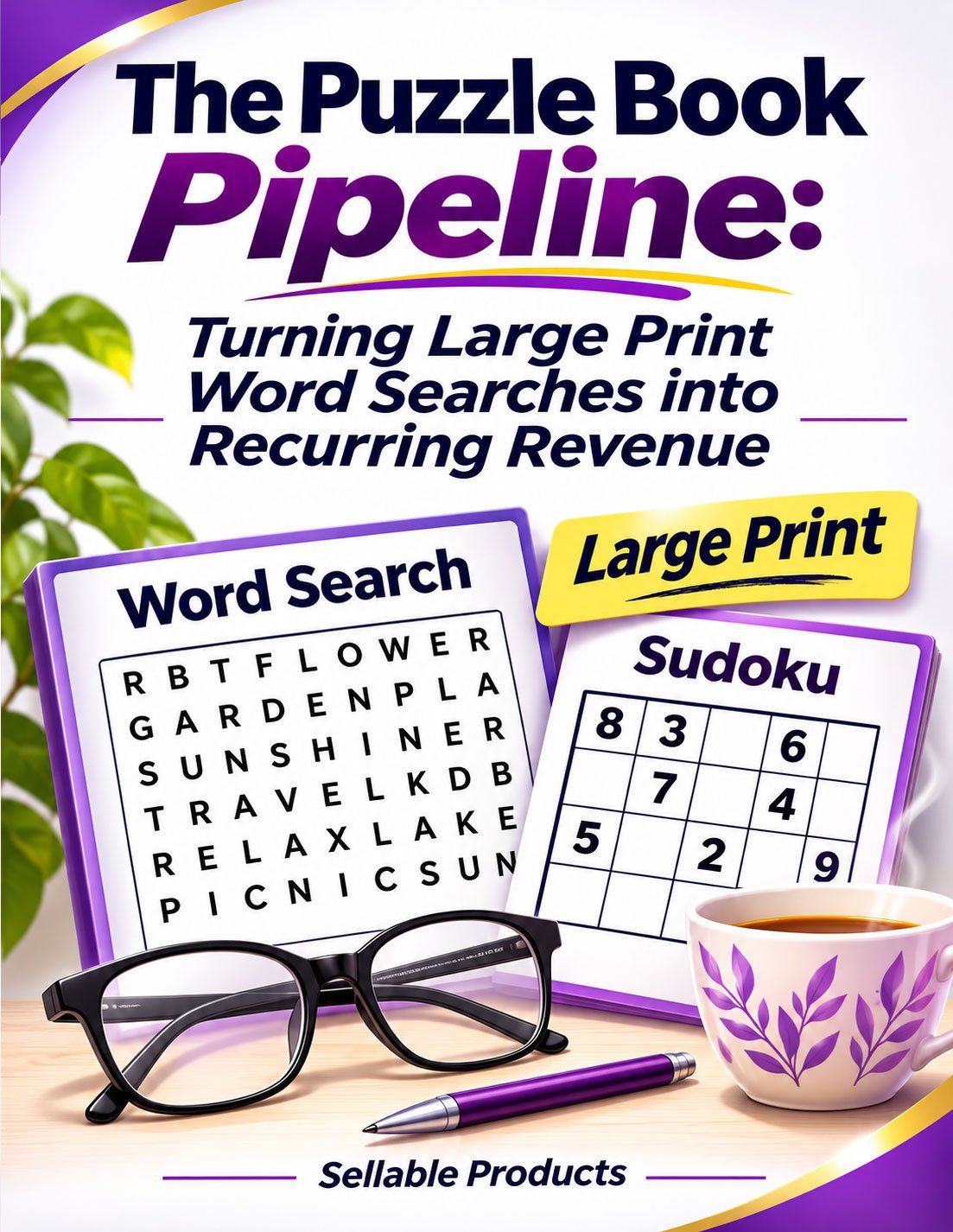
Get The Puzzle Book Pipeline: Turning Large Print Word Searches into Recurring Revenue
A practical, 24-page guide covering AI-assisted word lists, puzzle generation, large-print design, publishing preparation, and repeatable production.
Your first puzzle book can be the beginning of a much bigger collection.
Get Your Copy Today.
This guide teaches a publishing and production process. Recurring revenue is a potential business objective, not a guaranteed outcome. Actual sales depend on demand, quality, competition, discoverability, and continued effort.