Creators are constantly told to make more.
More posts.
More emails.
More videos.
More graphics.
More products.
More social content.
So every morning they open a blank screen and ask:
“What am I supposed to make today?”
That is the trap.
The problem is not that you need more ideas.
The problem is that you are throwing away the ones you already have.
A useful article gets posted once.
A good email disappears into the archive.
A smart framework gets turned into one tweet.
A strong product idea gets used in one PDF.
Then tomorrow?
Back to zero.
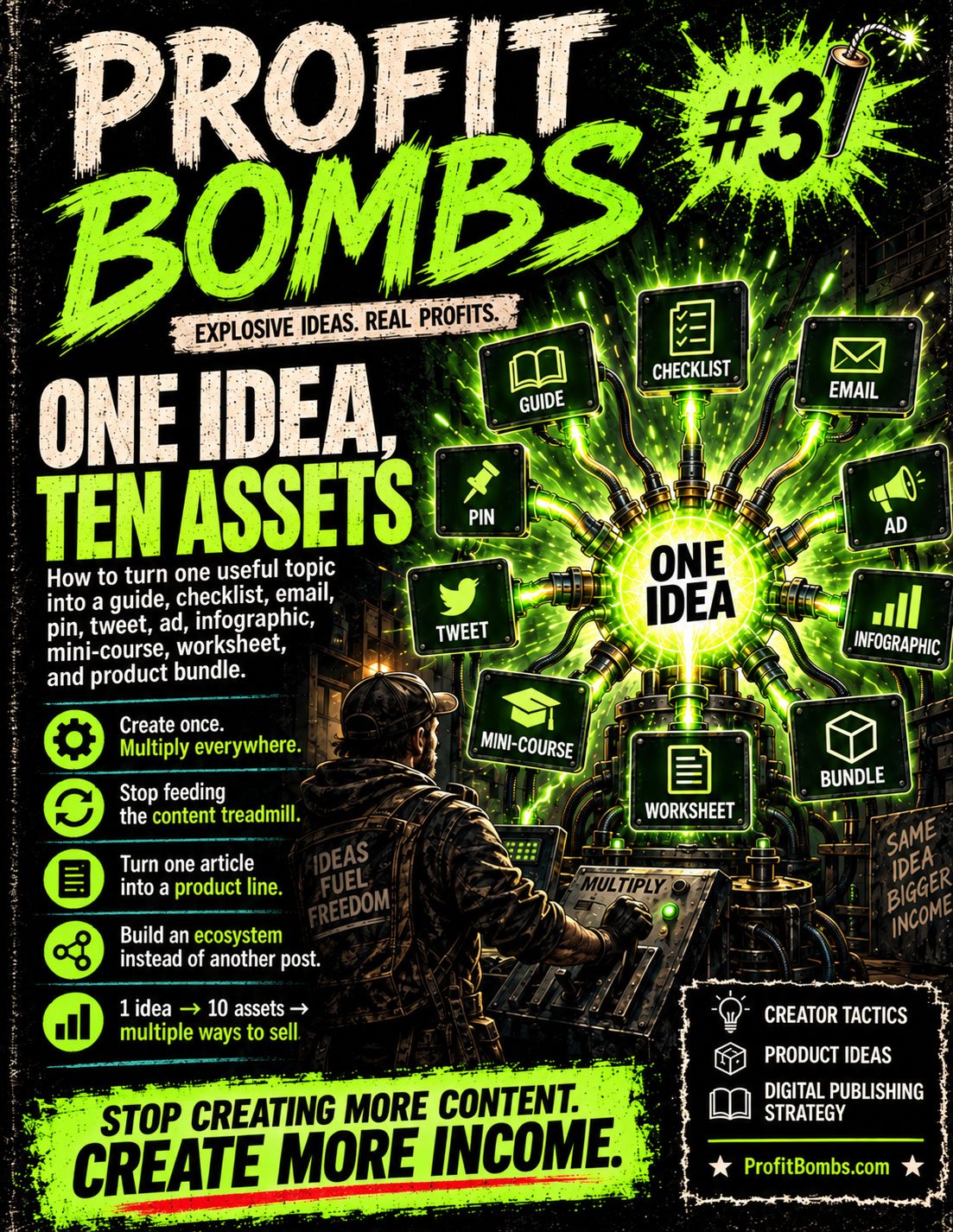
Profit Bombs #3: One Idea, Ten Assets shows you how to stop doing that.
One Idea Should Not Become One Piece of Content
A strong idea is raw material.
It should be mined.
Broken apart.
Reformatted.
Repackaged.
Connected to other assets.
One useful topic can become:
A guide.
A checklist.
An email.
A pin.
A tweet.
An ad.
An infographic.
A mini-course.
A worksheet.
A bundle.
Same core idea.
Different formats.
Different jobs.
More reach.
More usefulness.
More chances to sell.
That is asset multiplication.
And that is what this issue is built around.
Stop Creating Posts. Start Building Assets.
A post is temporary.
An asset can keep working.
A tweet can attract attention.
An article can deepen interest.
A checklist can help someone take action.
An email can build trust.
A guide can solve a problem.
A worksheet can help someone apply what they learned.
A mini-course can teach the process.
A bundle can turn the whole thing into a larger offer.
That is the difference between feeding the content machine and building your own.
Inside Profit Bombs #3
The One-Idea Rule
You’ll learn why the hardest part of creation is often finding and developing the useful idea in the first place.
Once you have it, throwing it away after one use makes no sense.
Instead of:
Idea → Post → Gone
You start thinking:
Idea → Asset System
One topic can become ten outputs without requiring ten separate ideas.
Because good ideas should compound, not disappear.
Asset Multiplication
This issue shows you the difference between duplication and multiplication.
You are not copying the same thing everywhere.
You are reshaping the same core idea for different jobs.
A guide explains.
A checklist activates.
An email nurtures.
A pin attracts.
A tweet provokes.
An ad converts.
An infographic simplifies.
A mini-course teaches.
A worksheet helps people apply.
A bundle monetizes.
The question changes from:
“How do I copy this everywhere?”
to:
“What job should this idea perform next?”
Same idea.
Different job.
Build a Content Ladder Instead of Random Content
Not every asset needs to sell directly.
Some assets should pull people deeper.
Inside, you’ll see how to build a simple ladder:
Attention
Tweets
Pins
Short posts
Ads
↓
Interest
Emails
Infographics
Articles
↓
Action
Checklists
Worksheets
Quick guides
↓
Revenue
Mini-courses
Paid guides
Bundles
Each rung should lead naturally to the next.
You are not just creating more content.
You are creating movement.
See the 10-Asset Machine in Action
The issue takes one concrete topic:
How to Find Your First Tiny Product Idea
Then turns it into ten separate assets:
1. Guide
Find Your First Tiny Product Idea
2. Checklist
10 Places to Look for Product Ideas
3. Email
You Probably Already Have Your First Product Idea
4. Pin
5 Places Product Ideas Hide
5. Tweet / Thread
Most people don’t need more ideas…
6. Ad
Turn what you already know into something sellable.
7. Infographic
From Raw Idea to Paid Product
8. Mini-Course
Tiny Product Idea Sprint
9. Worksheet
Product Idea Mining Sheet
10. Bundle
Guide + checklist + worksheet + mini-course
That is what multiplication actually looks like.
Ten assets does not mean ten ideas.
Turn One Article Into a Product Line
Articles are especially valuable because they already contain structure.
A headline.
Sections.
Claims.
Examples.
Steps.
Questions.
Frameworks.
Useful phrases.
That means one article can be broken apart and rebuilt into a complete product line.
Headline → ad hook
Sections → email series
Bullets → checklist
Examples → swipe file
Process → worksheet
Key ideas → infographic
Expanded explanation → guide
Exercises → mini-course
Best pieces → paid toolkit
Everything → bundle
The article is not the end product.
It is the mine.
Use the Extraction Map to Find What You Missed
A strong idea usually contains more value than you used the first time.
This issue gives you the questions to dig deeper:
What is the core principle?
What are the steps?
What mistakes do people make?
What examples make it clearer?
What could become a checklist?
What could become a worksheet?
What sentence could become a hook?
What visual would explain this instantly?
What piece could be sold alone?
What pieces belong together?
Then you move through five extraction zones:
Teach it.
Show it.
Apply it.
Promote it.
Package it.
Same idea.
More useful forms.
Stop Making Lonely Content
Most content online is disconnected.
One post points nowhere.
One email leads nowhere.
One product exists by itself.
That leaves money and momentum sitting on the table.
Profit Bombs #3 shows you how to connect assets into an ecosystem:
Tweet
↓
Article
↓
Free checklist
↓
Email series
↓
Paid guide
↓
Worksheet
↓
Mini-course
↓
Bundle
You do not need to build everything at once.
You build outward from the core.
Each asset should answer:
Where did they come from?
Where should they go next?
What deeper asset serves them next?
A post dies.
An ecosystem keeps moving.
Build the Asset Stack
This is where the leverage starts getting obvious.
One idea × ten assets = 10 assets
Ten ideas × ten assets = 100 assets
Twenty ideas × ten assets = 200 assets
You are no longer thinking in isolated posts.
You are building stacks.
Attention Stack
Posts
Tweets
Pins
Graphics
Trust Stack
Emails
Guides
Tutorials
Revenue Stack
Products
Courses
Bundles
But this is not permission to manufacture garbage for the sake of volume.
The core idea still matters.
Quality first.
Then multiplication.
The leverage is not volume.
It is reuse with purpose.
Build a Factory, Not a Feed
The final move is turning this into a repeatable production system.
The issue walks through a six-step workflow:
1. Choose one useful idea
2. Create the anchor asset
3. Extract the sub-assets
4. Assign formats
5. Connect the assets
6. Archive everything
Now your question is no longer:
“What do I post today?”
It becomes:
“What asset does this idea become next?”
That is a completely different way to operate.
It turns creation from a treadmill into a system.
Bonus: The One Idea → Ten Assets Checklist
Use the printable checklist to work through:
Your core idea
The useful lesson
The steps
Examples
Mistakes
Hooks
Visual opportunities
All ten formats
Connections between assets
Attention potential
Trust potential
Revenue potential
And your reusable asset library
The goal is simple:
Create once. Extract hard. Multiply smart.
Bonus: The Asset Multiplication Scorecard
Rate your idea from 1–5 across:
Strength of the core idea
Clear audience
Clear problem
Useful angles
Format variety
Attention potential
Trust-building potential
Revenue potential
Connection between assets
Reusability
Then find out whether your idea is:
40–50 — Asset Engine
Serious multiplication potential.
30–39 — Strong Core
Good foundation. Extract more.
20–29 — Underused Idea
You are leaving assets on the table.
Under 20 — Weak Core
The problem may be the original idea itself.
Who This Issue Is For
This is for creators, publishers, newsletter writers, digital product sellers, info marketers, prompt builders, small business owners, bloggers, and anyone sick of waking up every day feeling like the content clock reset overnight.
Especially if you already have:
Articles sitting around
Old newsletters
Useful frameworks
PDFs
Checklists
Good social posts
Product ideas
Research
Notes
Tutorials
Half-built projects
You probably do not need more raw material.
You need to work the material harder.
Stop Feeding the Content Machine
You do not need ten new ideas tomorrow.
You need more value from the good ideas you already have.
One topic.
Ten assets.
Different formats.
Different jobs.
One core idea.
That is how content becomes inventory.
That is how inventory becomes an ecosystem.
And that is how you stop staring at a blank screen every morning wondering:
“What the hell am I supposed to post today?”
ONE IDEA. TEN ASSETS. MORE LEVERAGE.
Get Profit Bombs #3: One Idea, Ten Assets