
Most creators are sitting on money.
Not in some magic guru way.
In their notes.
Their drafts.
Their checklists.
Their repeated advice.
Their half-finished ideas.
Their “I should turn this into something someday” folder.
The problem?
They think every product has to become a giant course.
A 47-module monster.
A polished funnel.
A big launch.
A huge brand.
A complicated automation machine.
So they wait.
They outline.
They overthink.
They research forever.
They add more sections.
They make the idea bigger until it becomes too heavy to finish.
And the product never ships.
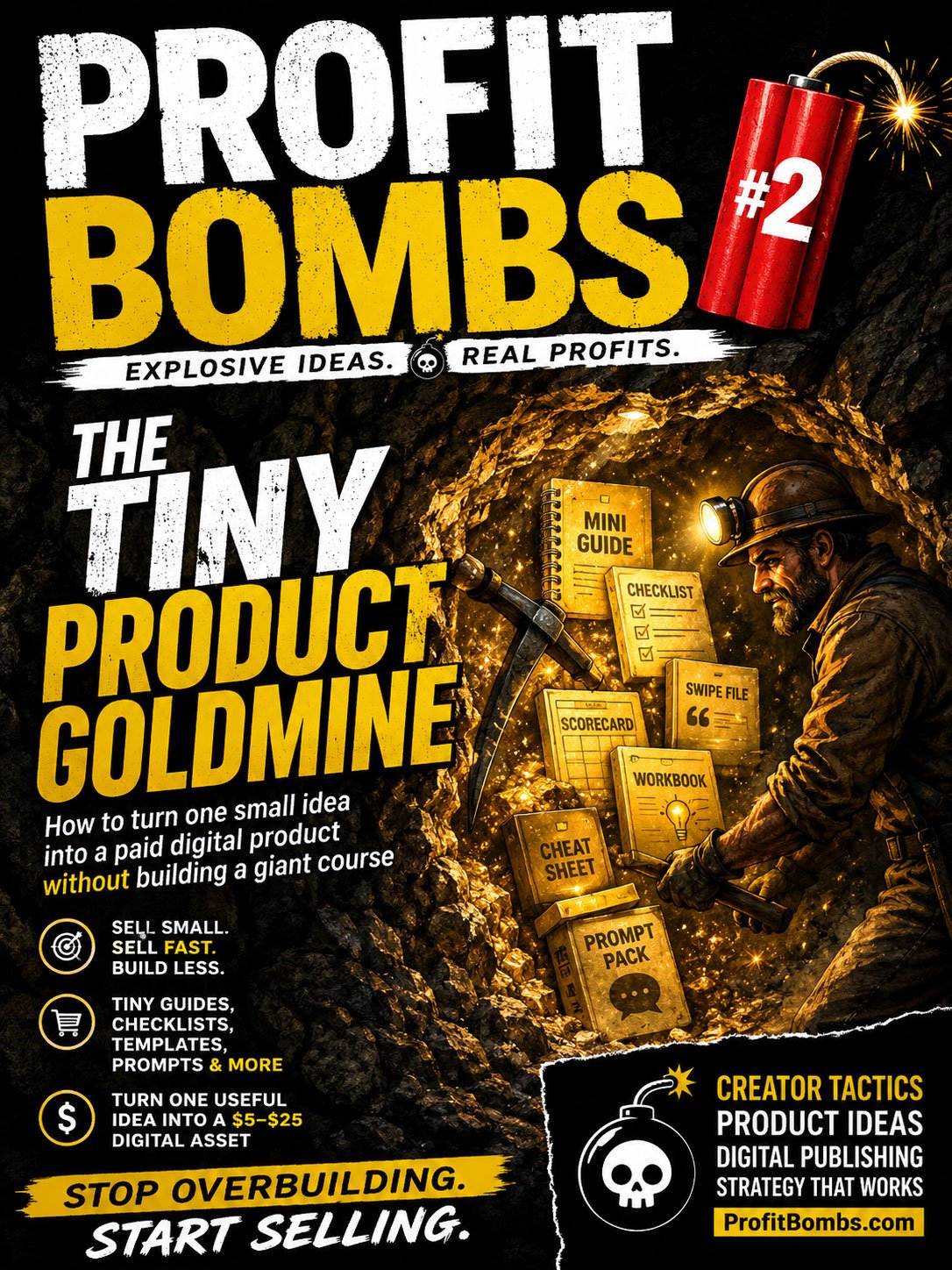
Profit Bombs #2: The Tiny Product Goldmine is the antidote.
This issue shows you how to take one small idea and turn it into a simple paid digital asset without building a giant course, giant funnel, or giant business machine first.
Small products are not weak. They are fast.
A tiny product solves one clear problem.
That could be:
- A short guide.
- A checklist.
- A template pack.
- A swipe file.
- A mini workbook.
- A scorecard.
- A cheat sheet.
- A prompt pack.
- A decision tree.
The goal is not to create the biggest product possible.
The goal is to create the clearest product possible.
Because people buy clarity faster than complexity.
A tiny product is easy to understand.
Easy to finish.
Easy to price.
Easy to buy.
Easy to sell.
That matters.
Especially when you are trying to build momentum instead of worshipping at the altar of unfinished “big ideas.”
Inside This Issue
You’ll learn how to spot tiny product ideas hiding in plain sight
Your next product may already be sitting in your notes app.
This issue shows you how to mine ideas from:
- Repeated advice you give people
- Unfinished blog drafts
- Customer questions
- Social posts that got attention
- Checklists you already use
- Old PDF fragments
- Frustrations and complaints
- Emails and DMs where you explained something clearly
A small product often starts as a useful fragment.
The money is in packaging it clearly.
You’ll learn the One-Problem Rule
The fastest way to ruin a tiny product is trying to make it do too much.
This issue gives you the simple filter:
- What problem does this solve?
- Who is it for?
- What useful result does it help create?
- Why is this easier than figuring it out alone?
That’s the move.
One problem.
One promise.
One clear result.
Narrow beats bloated.
Clear beats clever.
You’ll get 7 tiny product formats that sell
Do not default to a course.
There are faster, cleaner, easier formats.
Inside, you’ll break down:
- Quick Guides for teaching one clear concept
- Checklists for action and follow-through
- Template Packs for saving time
- Swipe Files for examples, prompts, and inspiration
- Scorecards for self-assessment
- Mini Workbooks for guided progress
- Cheat Sheets for quick reference
Pick the format that fits the job.
Not the format that makes you feel like you’re building an empire.
You’ll learn the 2-Hour Research Sweep
No six-month rabbit hole.
No pretending you’re writing a PhD thesis.
Just enough research to be useful.
The issue breaks the process into four focused blocks:
- 30 minutes to search pain points
- 30 minutes to collect examples
- 30 minutes to define the outcome
- 30 minutes to shape the product
Two hours of focus today can save weeks of guessing tomorrow.
You’ll learn how to build the product fast
Tiny products are supposed to ship.
This issue walks through a simple build path:
- Idea
- Outline
- Draft
- Clean up
- Export
- Sell
You’ll also get simple build structures for quick guides, checklists, and workbooks so you’re not staring at a blank page wondering where to start.
Done beats overbuilt.
Ship it.
Learn from it.
Improve it later.
You’ll learn how to name, promise, and position the product
Small products live or die on clarity.
A vague title kills the sale before the buyer even understands what you made.
This issue gives you the simple formula:
Result + Audience + Speed / Simplicity / Benefit
So instead of weak titles like:
“Digital Success Secrets”
You move toward clear titles like:
“Beginner Checklist for Selling Your First Digital Product”
No decoding.
No guru fog.
No cleverness that hides the value.
Good titles feel easy to buy.
You’ll learn how to price it low and make it easy
Tiny products work best when they are easy to say yes to.
Inside, you’ll get simple pricing zones:
- $3–$7 for impulse buys
- $9–$17 for strong low-ticket products
- $19–$27 for premium tiny assets or bundles
Low price does not mean low value.
It means low friction.
And low friction helps small products move.
You’ll learn how to sell it without a giant funnel
You do not need a marketing circus.
You need a simple buying path.
Attention → Product Page → Sale
That’s it.
This issue shows simple sales paths like:
- Social post → product page
- Email → product page
- Blog post → product mention
- Pinterest pin → landing page
- Free checklist → paid companion guide
- Product page → bundle offer
Tiny products win when buying them feels easier than ignoring them.
Bonus Tools Included
The Tiny Product Launch Checklist
A printable one-page checklist that helps you confirm:
- Your idea is clear
- Your format fits
- Your product is finished
- Your offer makes sense
- Your launch path is ready
No mystery.
Just check the boxes and ship.
The Tiny Product Scorecard
Rate your tiny product before you put it up for sale.
Score it on:
- Clear problem solved
- Strong title
- Useful outcome
- Right level of simplicity
- Easy to understand
- Easy to buy
- Fast to consume
- Good price point
- Good product format
- Good sales path
Then you’ll know if it’s ready to sell, needs tightening, or needs to be narrowed before launch.
Who This Is For
This is for creators, writers, info sellers, prompt builders, side hustlers, newsletter publishers, digital product people, and scrappy internet weirdos who are tired of turning every idea into a massive unfinished project.
It is for you if you have:
- Ideas but no finished products
- Old notes you could package
- Knowledge people ask you about
- A small audience you want to monetize
- A Payhip, Gumroad, Shopify, or simple product shop
- A desire to build small assets that stack over time
It is also for you if you keep saying:
“I should make something with this.”
Good.
Make something small.
Then sell it.
You Do Not Need the Ultimate Product
The internet is full of unfinished giant ideas.
Massive courses.
Overbuilt funnels.
Big dreams with no shipping date.
Tiny products flip that model.
One sharp idea.
One useful solution.
One fast asset people can actually buy.
That is how products begin.
That is how catalogs grow.
That is how momentum compounds.
You do not need to build the ultimate thing.
You need to build the next useful thing.
Get Profit Bombs #2: The Tiny Product Goldmine
Learn how to turn one small idea into a paid digital product without building a giant course.
Build small. Sell fast. Stack wins.