You don’t need a warehouse.
You don’t need thousands of dollars.
You don’t need to become an antique expert.
You just need to know what to look for, what people actually pay, and when to walk away.
That’s the idea behind:
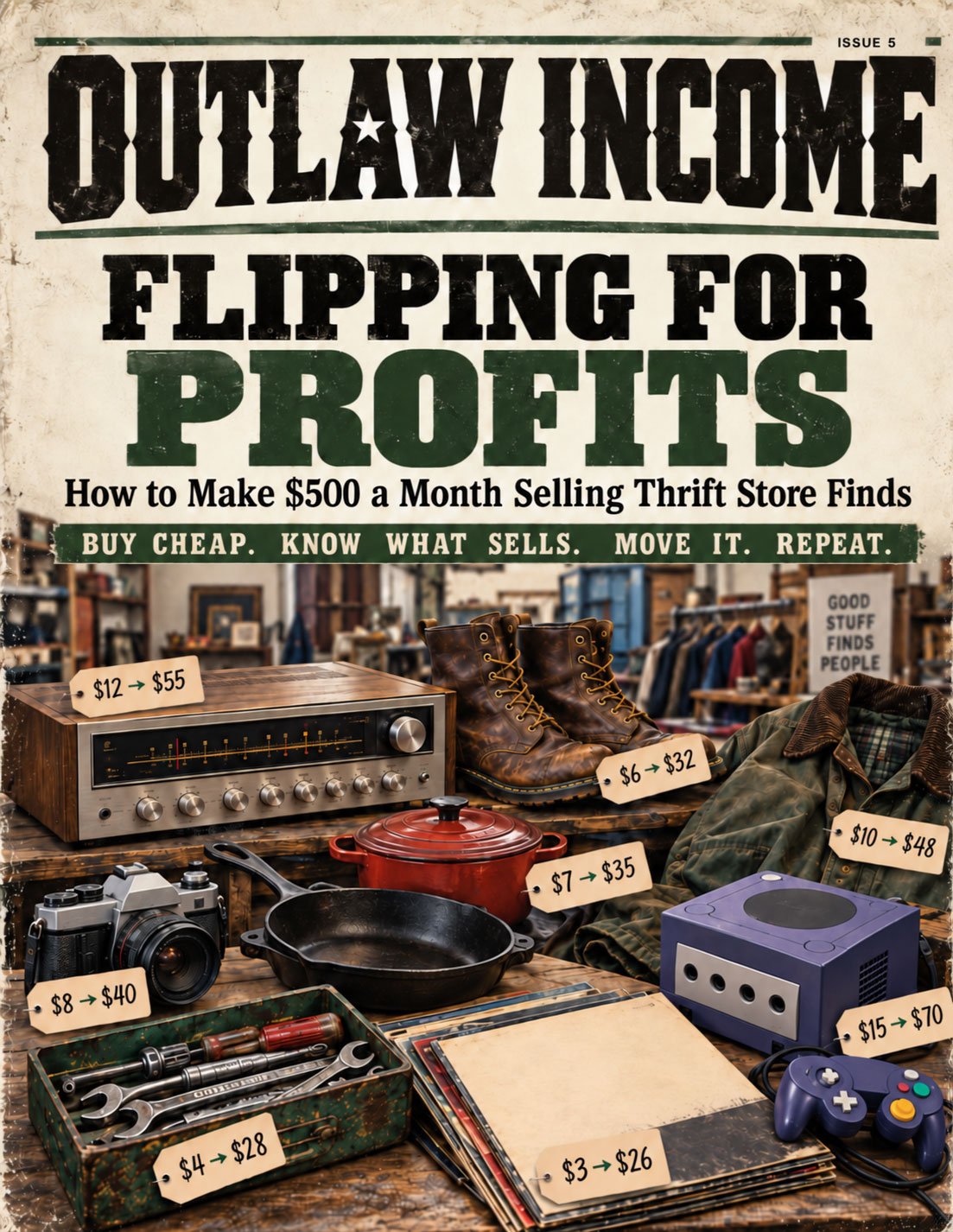
OUTLAW INCOME #5
FLIPPING FOR PROFITS
How to Make $500 a Month Selling Thrift Store Finds
Walk into almost any thrift store and you’ll see shelves full of old electronics, tools, jackets, kitchenware, shoes, games, books, collectibles and random household stuff.
Most shoppers see clutter.
A flipper sees something different:
Price gaps.
An item sitting on a shelf for $8 might regularly sell for $35 online.
A pair of boots marked $12 might have buyers paying $45.
A specialty tool somebody donated for almost nothing might be worth several times the thrift-store price.
The money isn’t in the fact that something is old.
The money is in knowing:
What somebody else will actually pay for it.
And that is exactly what this issue of Outlaw Income teaches you to do.
YOU ARE NOT HUNTING FOR TREASURE
You are hunting for small pricing mistakes that can be repeated.
That distinction matters.
You do not need to walk into a thrift store and magically discover a $2,000 antique.
You do not need encyclopedic knowledge of collectibles.
You do not need a garage packed floor-to-ceiling with inventory.
A much simpler model can work:
$25 average net profit × 20 sales = $500
Or:
$15 profit × 34 sales = about $510
That turns the goal from some vague dream about “making money reselling” into a simple operating target.
Find profitable items.
List them.
Sell them.
Track the numbers.
Repeat.
INSIDE FLIPPING FOR PROFITS, YOU’LL LEARN:
HOW TO SPOT A REAL PRICE GAP
Learn the basic flipping formula:
Local Price → Market Price → Selling Costs → Profit
Because a cheap item is not automatically a good buy.
A $3 item nobody wants is still a bad deal.
A $20 item that reliably sells for $80 could be far better.
You’ll learn the three questions that matter before almost every purchase:
Does somebody buy this?
What do they actually pay?
Is enough money left after costs?
WHY “SOLD” MATTERS MORE THAN “LISTED”
One of the easiest beginner mistakes is looking at active listings and assuming those prices represent value.
They don’t.
Anyone can ask $75.
That doesn’t mean anyone is paying $75.
If completed sales repeatedly show:
$27
$32
$34
$29
Then the real market is closer to $30, no matter how many sellers are dreaming about $75.
Inside the guide, you’ll learn how to use sold history instead of wishful thinking so you stop valuing your inventory against other people’s unsold inventory.
LEARN THE AISLES WORTH YOUR ATTENTION
You do not need to understand everything in the store.
Start with a few categories.
This issue breaks down seven approachable areas:
Small electronics
Tools
Shoes & boots
Jackets & workwear
Kitchenware
Toys & collectibles
Media, games & specialty books
For each category, you’ll see what to look for—and what should make you cautious.
Because the goal is not to know everything.
The goal is to know your things better than the average shopper.
USE THE 60-SECOND BUY TEST
Before putting something in your cart, run it through a fast five-step filter:
Can I identify it?
Can I find comparable sales?
Does it sell often enough?
Can I clear my minimum profit?
Can I realistically test, store and ship it?
Then make the decision:
BUY OR PASS.
That simple habit can save you from one of the biggest dangers in flipping:
Buying a lot of “interesting” stuff that never sells.
AVOID THE PROFIT TRAPS
Some thrift-store finds look much better than they really are.
Inside the issue, you’ll learn to recognize common traps like:
Heavy items with brutal shipping costs.
Electronics you cannot test.
Designer-looking items you cannot authenticate.
Fragile products with weak margins.
Incomplete sets.
Common collectibles with thousands already listed.
Cheap inventory with terrible sell-through.
Because paying $5 for something does not make it profitable.
Sometimes the smartest flip is the item you leave sitting on the shelf.
FIND INVENTORY OUTSIDE THE THRIFT STORE
Thrift stores are only one source.
You’ll also learn how to think about:
Flea markets
Yard sales
Estate sales
Church sales
Rummage sales
Local auctions
Facebook and local listings
Free piles
Different sources create different opportunities.
A thrift store offers consistency.
A yard sale may offer better negotiation.
An estate sale can concentrate specialty inventory in one place.
A flea market can create opportunities for repeat deals and bundles.
And sometimes the best negotiating position happens near the end of the sale, when the seller is more interested in moving inventory than taking it home.
TAKE THE $40 STARTING CHALLENGE
You do not need a huge bankroll to start learning.
The guide includes a simple exercise:
STARTING CASH: $40
Target four items averaging roughly $10 each.
Look for approximately $20 or more potential net profit per item.
Then:
BUY → LIST → SELL → TRACK → REINVEST
The point is not to promise some magical return.
The point is to teach the complete flipping cycle using a small amount of money.
One of the rules inside the issue is simple:
DON’T ADD NEW MONEY UNTIL YOU UNDERSTAND WHAT HAPPENED TO THE OLD MONEY.
That keeps flipping from turning into random shopping disguised as a business.
LEARN TO CREATE LISTINGS THAT ACTUALLY HELP SELL THE ITEM
Finding a profitable item is only half the job.
A weak listing can kill a good find.
You’ll learn how to improve:
PHOTOS
Bright. Clean. Multiple angles.
TITLES
Brand + model + item + size/spec + useful keywords.
DESCRIPTIONS
Condition. Defects. Included parts. Measurements where useful.
PRICING
Based on real sold evidence.
TRUST
Show flaws instead of hiding them.
You’ll also get a simple five-photo system:
- Full item
- Reverse
- Label/model
- Detail
- Damage/flaw
Because buyers are much more comfortable purchasing something when they can clearly see what they’re getting.
DON’T LET SHIPPING EAT THE FLIP
A product can look profitable right up until you calculate what it costs to get it to the buyer.
This issue walks through the shipping factors beginners often underestimate:
Boxes.
Padding.
Shipping zones.
Dimensional weight.
Fragility.
Returns caused by poor packaging.
You’ll also see a simple beginner classification:
GREEN LIGHT
Books, clothing, shoes, compact tools and small electronics.
YELLOW LIGHT
Cookware, awkward equipment and larger toys.
RED LIGHT FOR BEGINNERS
Huge speakers, glassware, furniture and very heavy machinery.
The rule:
KNOW HOW YOU’LL SHIP IT BEFORE YOU BUY IT.
BUILD YOUR OWN PERSONAL MONEY MAP
Eventually, flipping gets easier.
Not because thrift stores become more predictable.
Because you get better.
After enough sourcing trips, you stop researching every object from scratch.
You begin recognizing:
THAT MODEL.
THAT LABEL.
THAT TOOL.
THAT ERA.
The guide helps you build your own 10-item watchlist with:
Buy-under prices.
Typical sale prices.
Target profits.
Known condition issues.
Shipping considerations.
Over time, your knowledge becomes the asset.
The thrift store is simply where you deploy it.
ALSO INCLUDED:
THE THRIFT FLIP FIELD CHECKLIST
A practical before-buying, after-buying and after-selling checklist to help you avoid sloppy decisions.
Track things like:
Sold prices.
Condition.
Missing parts.
Fees.
Shipping.
Packaging.
Expected profit.
Actual profit.
Lessons learned.
And reinvestment.
PLUS: THE FLIPPING BUSINESS SCORECARD
Ask yourself:
ARE YOU BUILDING A FLIPPING BUSINESS — OR A PILE OF STUFF?
Score yourself on:
Sourcing discipline.
Profit discipline.
Market knowledge.
Listing speed.
Sell-through.
Storage.
Shipping.
Record keeping.
Reinvestment.
And your ability to leave questionable items behind.
Your score lands you in one of four categories:
17–20 — SHARP FLIPPER
12–16 — PROFITABLE BONES
7–11 — INVENTORY DRIFT
0–6 — THRIFT STORE DONOR
If that last one hurts a little, good.
It is supposed to.
FLIPPING DOESN’T HAVE TO BECOME YOUR WHOLE LIFE
That is the point of Outlaw Income.
Small operations.
Useful income.
No empire required.
You can learn a handful of categories.
Source a few times each month.
List a few items each week.
Build your knowledge.
Improve your buying discipline.
And work toward a simple target like $500 a month without turning your house into a warehouse.
You do not need every opportunity.
You need enough good ones.
THERE IS NO MONEY IN OLD STUFF.
THE MONEY IS IN KNOWING WHICH OLD STUFF SOMEBODY ELSE WANTS.
Start with one shelf.
Find one price gap.
Make one flip.
Repeat.
GET OUTLAW INCOME #5
FLIPPING FOR PROFITS
How to Make $500 a Month Selling Thrift Store Finds
BUY CHEAP. KNOW WHAT SELLS. MOVE IT. REPEAT.