Most plans work fine right up until reality changes.
The customer reacts differently than expected.
The launch underperforms.
The project stalls.
The market shifts.
The thing that worked last month suddenly stops working.
And that is where a lot of people make the wrong move.
They cling harder to the original plan.
They gather more information.
They overthink.
They panic-pivot.
Or they keep making changes without learning anything from them.
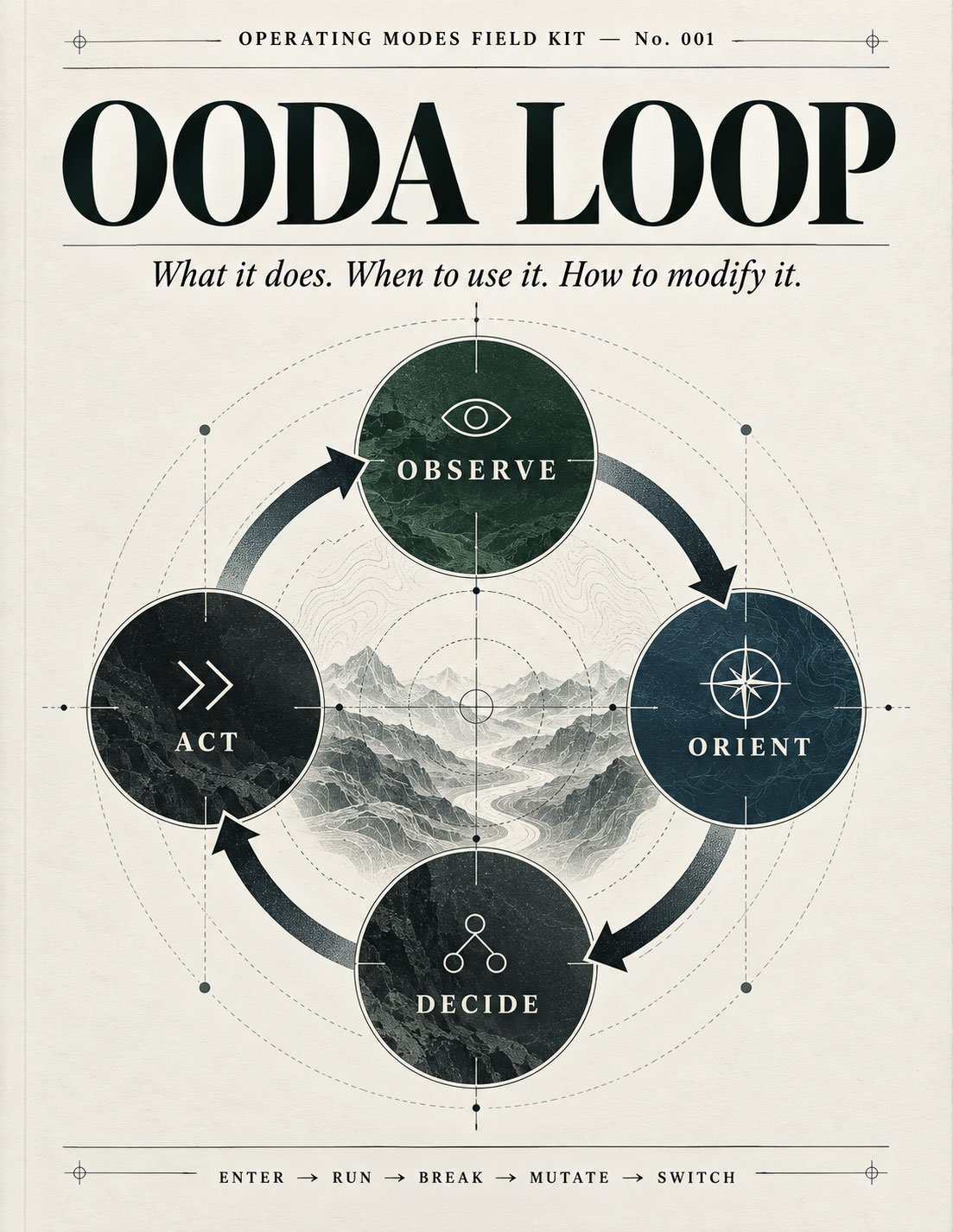
OODA LOOP gives you another way to operate.
Observe what is actually happening.
Orient yourself to what it means.
Decide on the strongest next move.
Act.
Then use the result as new information.
And run the loop again.
THIS IS NOT A BOOK ABOUT “THINKING FASTER”
OODA is usually explained as a military decision-making framework.
That barely scratches the surface of what makes it useful.
This Field Kit turns OODA into a practical operating mode for situations where:
- information is incomplete
- conditions are changing
- feedback arrives quickly
- your current plan is producing surprises
- small tests can teach you more than more analysis
The goal is not blind speed.
The goal is to learn faster than the situation changes.
INSIDE THE FIELD KIT
You will not just learn what OODA means.
You will learn how to actually run it.
THE MODE
A plain-English explanation of OODA without burying the useful idea under jargon.
THE MACHINE
See how the loop really works:
OBSERVE → ORIENT → DECIDE → ACT → NEW REALITY → OBSERVE AGAIN
INSIDE THE MACHINE
Go beneath the visible framework and see the deeper learning cycle:
ASSUMPTION → TEST → FEEDBACK → UPDATED ASSUMPTION
THE TRIGGER
Know exactly when OODA is useful—and when it is not.
Includes a practical trigger test you can run before entering the mode.
RUN THE MODE
Work through the full OODA cycle with guided worksheets for:
OBSERVE
Separate facts from interpretation.
ORIENT
Challenge assumptions and generate alternative explanations.
DECIDE
Compare realistic next moves by cost, reversibility, learning value, and expected result.
ACT
Define exactly what you will do, what you expect to happen, and what signal would prove you wrong.
LOOP
Review the result and decide whether to:
LOOP AGAIN
MUTATE
SWITCH
or
STOP
MOVEMENT IS NOT LEARNING
One of the biggest OODA mistakes is confusing activity with progress.
So this kit includes a Loop Quality Performance Check.
Score each cycle on:
- Information
- Position
- Options
- Understanding
- Leverage
Total score: /10
A low score means you may not be adapting.
You may just be spinning.
SEE OODA OPERATING IN THE REAL WORLD
The kit applies OODA to situations far outside its usual military context.
Including:
- launches
- negotiation
- troubleshooting
- marketplace selling
- content
- project development
You also get six compact Mini Loops showing how the same framework can be carried into:
- a bad ad campaign
- a thrift store
- a failed email
- a broken workflow
- a client negotiation
- a new routine
Because a framework becomes genuinely useful when you can carry it into unfamiliar terrain.
LEARN HOW OODA FAILS
Most framework books teach you how to use the system.
They rarely teach you how to recognize when the system itself is becoming the problem.
This one does.
You will learn to identify:
PANIC LOOPING
Every signal causes another strategy change.
ENDLESS ORIENTATION
Research and analysis replace action.
DECISION ATTACHMENT
You defend yesterday’s decision even when today’s evidence contradicts it.
RANDOM ACTION
You keep changing things without a clear hypothesis.
And then go deeper into:
- too many variables
- overuse
- looping after stability
- acting on noise
Because knowing when a framework fails is part of knowing the framework.
THREE WAYS TO MUTATE OODA
The framework is not sacred.
Change it to fit the situation.
COMPRESS — RAPID OODA
Use tighter loops when time is limited and the cost of being wrong is low.
EXPAND — DEEP OODA
Slow the cycle down when stakes are higher and the situation needs more observation and orientation.
HYBRIDIZE — PARALLEL OODA
Run multiple small loops when several plausible paths need testing at once.
Every mutation includes:
- when to use it
- how to modify the loop
- what risk to watch for
THE FIELD TEST
The kit walks through one complete worked example:
THE THRIFT STORE THAT STOPPED WORKING
A reseller has successfully sourced electronics from the same store for months.
Then the electronics dry up.
The easy conclusion:
The opportunity is gone.
OODA reveals something more interesting.
The category changed.
Tools and work boots are now producing better buying opportunities.
The deeper lesson:
The advantage was not knowing where to find electronics.
The advantage was knowing how to recognize pricing gaps.
That is what OODA is really built to protect:
Your ability to see when the winning pattern has moved.
THE AI VERSION
AI can make OODA more useful—but only if you use it correctly.
The kit shows how AI can help with:
- separating facts from assumptions
- identifying alternative explanations
- proposing reversible tests
- comparing results
And what it should not do:
- invent missing facts
- decide what reality means without evidence
- replace real-world testing
You also get a ready-to-use:
OODA COPILOT PROMPT
Give it your situation, objective, and observations.
It helps you sort signals, challenge assumptions, generate plausible explanations, identify reversible moves, and define what should trigger the next loop.
AI helps you think.
Reality still gets the final vote.
AND THEN COMES THE PART MOST FRAMEWORKS FORGET
THE SWITCH
OODA is not supposed to become permanent.
Sometimes conditions stabilize.
Sometimes a repeatable process emerges.
Sometimes the real problem becomes diagnostic.
Sometimes only one unknown remains.
Sometimes the direction finally becomes clear.
That is when you leave OODA and switch into another mode.
The kit shows when to move toward:
CHECKLIST MODE
SYSTEM MODE
DIAGNOSTIC MODE
EXPERIMENT MODE
PLANNING MODE
Because:
A MODE IS USEFUL BECAUSE YOU CAN LEAVE IT.
INCLUDED: THE OODA MODE CARD
A compact tear-out reference page that puts the entire system in one place.
Includes:
- Trigger conditions
- Core sequence
- Five essential questions
- Failure signs
- Mutations
- Common switch modes
And the reminder:
DON’T BUILD A BETTER PLAN FOR A WORLD THAT HAS ALREADY CHANGED.
THIS IS THE FIRST OPERATING MODES FIELD KIT
The larger series is built around one simple idea:
Different situations require different ways of operating.
So instead of treating frameworks like permanent philosophies, Operating Modes turns them into tools you can:
ENTER → RUN → BREAK → MUTATE → SWITCH
You are not trying to find the one framework that solves everything.
You are building a repertoire of ways to operate.
OPERATING MODES FIELD KIT — No. 001
OODA LOOP
What it does.
When to use it.
How to modify it.
For creators, operators, entrepreneurs, problem-solvers, and anyone working in situations where reality refuses to stay still.
Observe what is happening.
Interpret what it means.
Choose the next move.
Act.
Look again.