Every part of modern life comes with a gatekeeper.
A bank decides whether you can access your money.
A platform decides whether you can reach the audience you built.
A cloud service holds the only copy of your work.
A manufacturer decides whether the equipment you bought can be repaired.
A bureaucracy loses a document—and somehow makes it your problem.
Everything works beautifully until permission is withdrawn.
Then you discover how many parts of your life depend on one account, one company, one credential, one device, or one person behind a counter saying:
“There’s nothing else I can do.”
Usually, that isn’t true.
There may be another account.
Another payment rail.
Another communication channel.
Another filing procedure.position.
Another route through the machinery.
You just have to build it before you desperately need it.
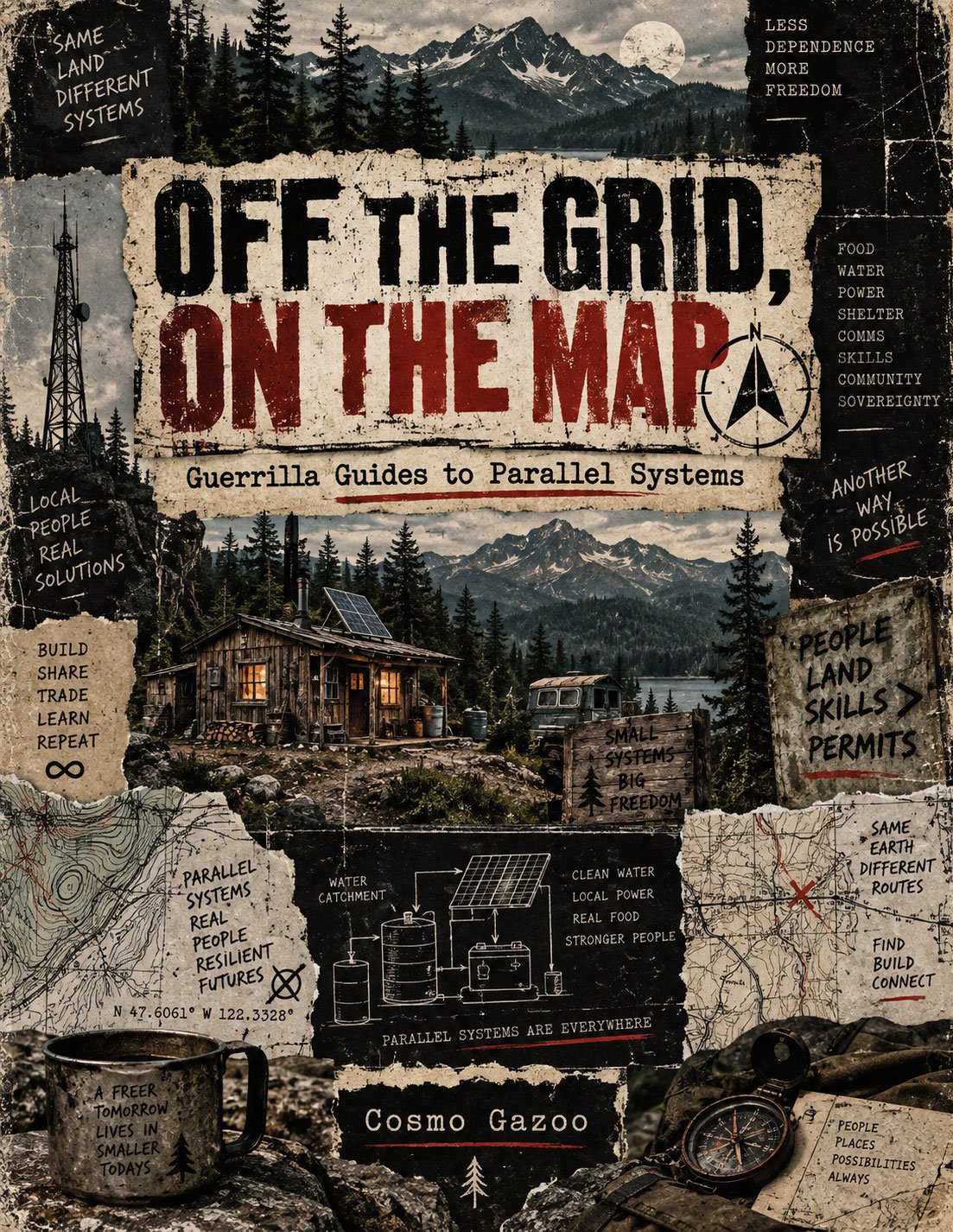
OFF THE GRID, ON THE MAP
Guerrilla Guides to Parallel Systems
Encryption, lawful loopholes, direct exchange, backup infrastructure, and paperwork jiu-jitsu for operating inside the system without being owned by it.
This is not another fantasy about running into the woods and disappearing.
It is not sovereign-citizen nonsense.
It is not a pile of expensive survival gear
waiting for civilization to collapse.
And it is definitely not advice about hiding money, falsifying records, or pretending laws stop applying because somebody discovered a strange paragraph on the internet.
Off the Grid, On the Map is a practical field manual for people who intend to remain functional when the standard route stops working.
It shows you how to identify the systems that can corner you, build lawful alternatives around them, protect the records that establish your rights, and navigate institutions without surrendering more control than necessary.
THE REAL THREAT ISN’T “THE SYSTEM.”
It’s having only one route through it.
One bank account.
One payment processor.
One marketplace.
One copy of your files.
One source of power.
One way to communicate.
One device that controls account recovery.
One institution holding the document you need to challenge that same institution.
That is how inconvenience turns into leverage.
A frozen account becomes lost income.
A failed device becomes lost work.
A platform ban becomes the disappearance of an entire audience.
A missing form becomes months of delay.
A power outage becomes a household emergency.
A forgotten deadline becomes a final decision.
The answer is not total independence. Nobody produces their own medicine, fuel, tools, communication equipment, legal system, and supply chain.
The answer is parallel capacity.
You use the primary system—but maintain another route.
You use the platform—but keep the files.
You use the cloud—but own a local copy.
You use the bank—but keep another financial rail.
You call the agency—but turn the conversation into a written record.
You participate strategically without making any gatekeeper your only option.
INSIDE THE REPORT
MAP THE CAGE
Conduct a complete dependency audit across money, housing, utilities, transportation, healthcare, identity, communications, business, and digital assets.
You’ll learn how to identify:
- Single points of failure
- Hidden permission layers
- Fragile account dependencies
- Missing records
- Untested backups
- Systems capable of triggering a failure cascade
Then you’ll rank each part of your life on the Autonomy Ladder, moving from complete dependence toward genuine resilience.
BECOME LEGIBLE ON YOUR TERMS
Not every institution needs access to every part of your life.
Learn the difference between information that is legally required, contractually necessary, optionally requested, and collected merely because surrender has become the default.
You’ll build a lawful separation between:
- Personal identity
- Public identity
- Business identity
- Creative identity
- Account and recovery channels
You’ll also create an Evidence Vault containing the records that prove your identity, ownership, agreements, payments, rights, and history.
Because when something goes wrong, your memory is not the record.
The record is the record.
ENCRYPTION WITHOUT THE HACKER THEATER
Privacy does not require thirty confusing applications and a paranoid worldview.
It requires knowing what you are protecting, what could threaten it, and which basic practices reduce the most risk.
The report walks through a Minimum Viable Privacy Stack covering:
- Unique passwords
- Password management
- Multifactor authentication
- Device encryption
- Encrypted messaging
- Secure backups
- Recovery codes
- App permissions
- Metadata exposure
You’ll also get a 30-Minute Privacy Hardening Drill that improves your security without making your own accounts impossible to use.
MONEY WITH MORE THAN ONE DOOR
Modern money travels through private gates: banks, card networks, payment processors, marketplaces, identity vendors, and automated fraud systems.
If one company controls the entire route between your work and your usable income, you do not have a payment system.
You have a financial chokepoint.
Learn how to construct a lawful, documented multi-rail system using:
- Primary and secondary financial institutions
- Direct invoicing
- Multiple payment methods
- Emergency cash
- Local exchange
- Direct customer relationships
- Platform, independent, and physical income channels
You’ll also see the real meaning of the “shadow economy”: not stacks of contraband and anonymous briefcases, but ordinary direct exchange taking place beyond the corporate platform funnel.
Repair work.
Local markets.
Barter.
Secondhand trade.
Referrals.
Cooperative purchasing.
Independent publishing.
Direct patronage.
Informal does not mean illegal. It means fewer intermediaries standing between two people who have agreed to exchange value.
PAPERWORK JIU-JITSU
This is the centerpiece of the report.
Bureaucracy does not run on fairness, anger, or common sense.
It runs on records, classifications, procedures, authority, and time.
Being right is not enough if you cannot prove:
- What happened
- When it happened
- Who was notified
- What evidence was supplied
- Which rule applies
- What remedy you requested
- Whether you met the deadline
Paperwork Jiu-Jitsu teaches you how to transform scattered calls and frustrating encounters into an administrative record that is calm, organized, and difficult to dismiss.
You’ll learn how to:
- Turn important calls into written records
- Build a chronological dispute file
- Make an institution identify the governing rule
- Separate policy from employee habit
- Request a specific remedy
- Climb the escalation ladder intelligently
- Preserve proof of delivery
- Protect yourself against deadline games
- File an effective appeal or reconsideration request
- Recognize when professional help is necessary
The report includes a reusable contact log, document index, dispute-letter framework, and a simple escalation system.
No fake liens.
No secret punctuation spells.
No imaginary legal identities.
Just the institution’s own procedures turned into leverage.
THE PARALLEL HOUSEHOLD
Parallel living begins with ordinary capacity:
- Stored water
- Backup lighting
- Alternative cooking
- Temperature protection
- Communication
- Power redundancy
- Repair tools
- Offline instructions
- Essential spare parts
- A household continuity binder
You’ll learn how to duplicate essential functions without filling your home with expensive equipment you cannot maintain.
The goal is not to prepare for the end of civilization.
The goal is to prevent a small failure from becoming a personal crisis.
NETWORKS BEAT LONE WOLVES
Self-sufficiency is mostly mythology.
Resilient people depend on others—but they choose stronger, more reciprocal forms of dependence.
The report shows how to build a local capability network involving repairers, growers, merchants, tradespeople, medical professionals, administrators, artists, organizers, and neighbors.
You’ll learn how to establish clear boundaries around mutual aid, loans, tools, transportation, labor, and shared responsibility.
Because reputation, reliability, and reciprocity can open routes no platform knows how to create.
EXIT WITHOUT DESTROYING YOUR OWN ASSETS
Rage-quitting a platform feels powerful until you realize it contained your customer records, invoices, messages, photographs, contacts, tax documents, and account recovery information.
Before leaving any critical system, you need a controlled exit.
The report provides an exit sequence for:
- Exporting records
- Moving authentication
- Preserving evidence
- Testing replacements
- Closing financial loops
- Protecting contacts
- Confirming cancellation
- Monitoring final charges and notices
Use the bridge.
Just don’t build your house on it.
BUILT FOR USE—NOT PASSIVE READING
Off the Grid, On the Map includes a complete Field Kit:
- The Parallel Systems Audit
- Dependency scoring system
- Primary Chokepoint Map
- Contact Log
- Document Index
- Dispute Letter Skeleton
- Three-Rail Income Map
- Ten-Person Capability Map
- Household Continuity framework
- 30-Day Parallelization Plan
- Red-Line List separating lawful leverage from fraud and pseudo-law
You can read the report in one sitting.
Then use it to systematically remove the weak links from your life.
THIS IS FOR YOU IF:
- You are tired of being helpless when a platform or institution makes a mistake.
- You want more privacy without turning your life into an espionage operation.
- You operate a small business, independent project, or unconventional household.
- You want direct income routes that do not depend entirely on algorithms.
- You believe ownership should include access, repair, portability, and control.
- You want to understand bureaucracy instead of merely becoming furious at it.
- You value self-reliance but recognize that strong networks beat lone-wolf fantasies.
- You want practical independence that works now—not after some imagined collapse.
FREEDOM IS NOT THE ABSENCE OF SYSTEMS.
It is the ability to choose among them.
Challenge them.
Replace them.
Document their failures.
And remain functional when one of them shuts the door.
The work is rarely cinematic.
It looks like exported files.
Tested batteries.
Protected records.
Alternate accounts.
Clean bookkeeping.
Written confirmations.
Direct customers.
Maintained relationships.
Spare parts.
Deadlines entered on a calendar.
That is precisely why it works.
Institutions expect angry calls, missing receipts, forgotten passwords, expired deadlines, and total dependence.
They are less prepared for someone who knows the process, documents the facts, asks for the governing rule, requests a defined remedy, and already has another route.
OWN THE RECORDS.
KNOW THE RULES.
DUPLICATE THE ROUTES.
TEST THE BACKUPS.
PROTECT THE RELATIONSHIPS.
DOCUMENT THE DISPUTE.
Never give one gatekeeper the whole map.
Get Off the Grid, On the Map and start building a life that remains yours—even when permission is withdrawn.