When people hear the words “rigged election,” they usually imagine stolen ballots, hacked machines or fraudulent vote counts.
But election manipulation does not always happen that way.
It can begin months—or years—before Election Day.
It can happen through district boundaries designed to predetermine representation.
Through rules that make voting easier for some citizens and harder for others.
Through false information about polling places, identification requirements and ballot deadlines.
Through manufactured claims intended to frighten voters, discourage participation or destroy public confidence.
Through vulnerable technology, hidden financial influence and systems so complicated that most citizens never understand where the real pressure points are.
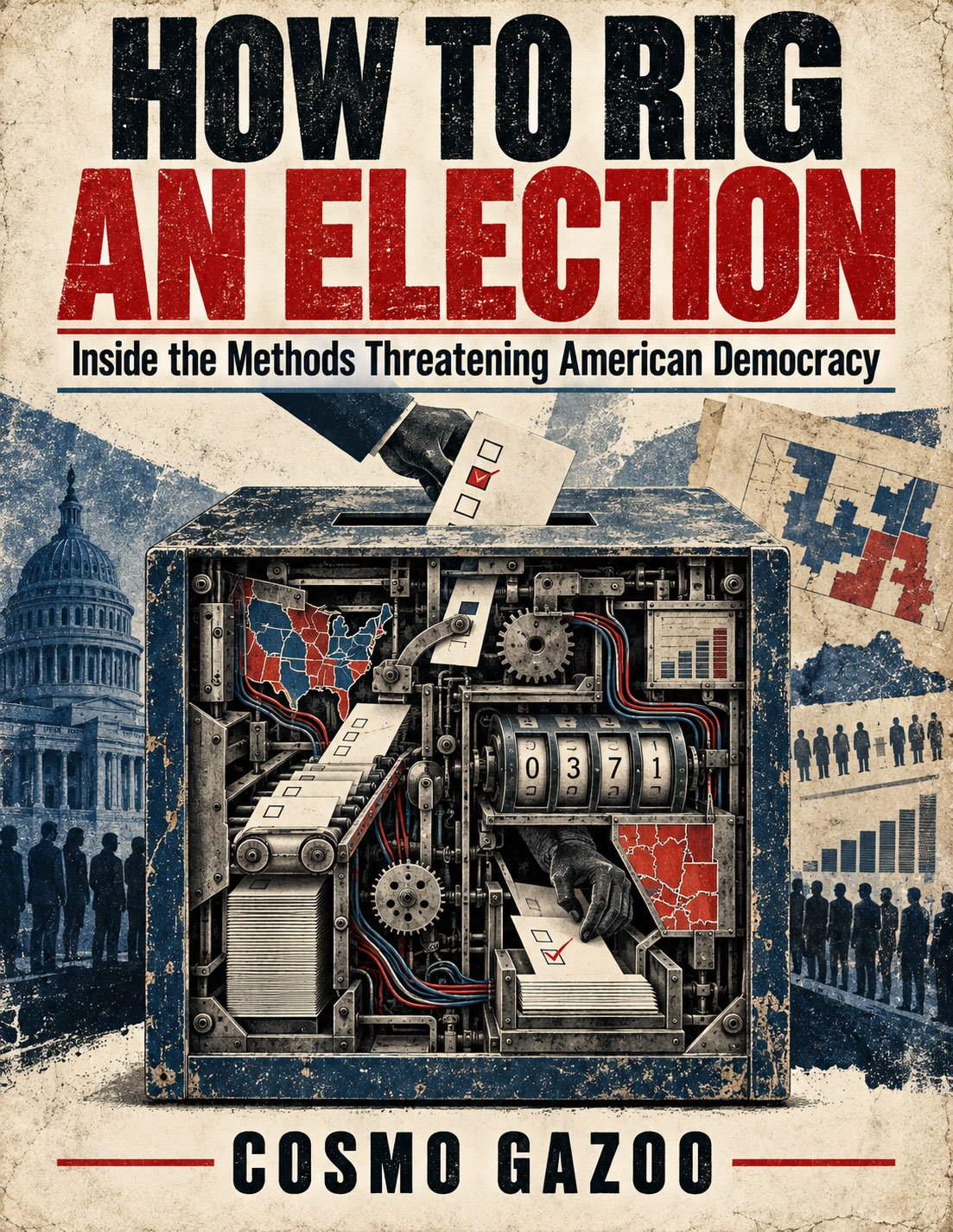
HOW TO RIG AN ELECTION
Inside the Methods Threatening American Democracy
This concise investigative report examines the methods that can distort American elections—without reducing the subject to another round of partisan shouting.
It does not tell you which party to trust.
It shows you which methods to recognize.
THIS IS NOT A MANUAL FOR COMMITTING ELECTION CRIMES
Despite its provocative title, How to Rig an Election does not encourage illegal activity or teach readers how to interfere with an election.
It is an educational field guide to the weaknesses, influence mechanisms and manipulation tactics that every informed citizen should understand.
Because you cannot recognize pressure on a democratic system if you do not know where that pressure can be applied.
INSIDE THE REPORT
Voter Suppression Tactics
Examine how identification requirements, polling-place reductions, voter-roll maintenance, restricted voting periods, misleading information and intimidation can create barriers between eligible citizens and the ballot box.
Gerrymandering
Understand the techniques known as packing and cracking—and how district boundaries can be drawn to strengthen one political interest while weakening another.
The Supreme Court ruled in Rucho v. Common Cause that partisan-gerrymandering claims present political questions beyond the reach of federal courts, leaving much of the battle to Congress and the states. Read the Supreme Court decision.
Voter Misinformation
Discover how false voting dates, fabricated eligibility requirements, deceptive messages and manipulated online narratives can affect participation without physically touching a ballot.
The FBI and CISA have publicly warned that false claims about compromised election infrastructure may be circulated to confuse voters and undermine confidence in elections. Read the joint public-service announcement.
Fraud Narratives and Discouragement
Learn how unsupported accusations, threatening messages and manufactured suspicion can be used to frighten eligible voters or convince the public that legitimate results cannot be trusted.
Absentee and Mail-In Ballots
Explore the arguments, access restrictions, delivery problems, collection controversies and security concerns surrounding voting by mail.
Voting Technology and Cybersecurity
Look inside the risks associated with electronic voting systems, aging equipment, insecure software and digital election infrastructure—as well as the role of paper records and post-election audits.
The U.S. Election Assistance Commission describes audits as an important means of checking vote-counting equipment and procedures against paper records. See the EAC’s audit guidance.
Campaign Finance and Dark Money
Follow the influence of Super PACs, nonprofit organizations, intermediary groups and financial structures that can make the original sources of political spending difficult for ordinary voters to see.
The Federal Election Commission confirms that independent-expenditure-only committees—commonly called Super PACs—may accept unlimited contributions from individuals, corporations, labor organizations and other political committees. See the FEC guidance.
THE REAL QUESTION ISN’T WHETHER YOUR SIDE CAN CHEAT
The real question is whether any political organization, wealthy interest, foreign actor, government official or private institution can exploit weaknesses in the system.
That is why this report focuses on the machinery rather than the team colors.
Manipulation does not become acceptable because your preferred side benefits from it.
Election integrity only means something when the same standards apply to everyone.
WRITTEN FOR INDEPENDENT MINDS
How to Rig an Election is for readers who:
- Suspect the public debate is missing the deeper mechanisms
- Want to understand elections beyond campaign speeches and television arguments
- Refuse to outsource their judgment to a political party
- Care about voting access and election security at the same time
- Want a compact introduction without reading hundreds of pages of legal language
- Believe democracy is stronger when citizens understand how it can be manipulated
WHAT YOU RECEIVE
A professionally designed 19-page digital report covering seven major pressure points in American elections:
- Voter suppression
- Gerrymandering
- Voter misinformation
- Fraud narratives and discouragement
- Absentee and mail-in ballot manipulation
- Voting technology and hacking risks
- Campaign finance loopholes and dark money
Written by Cosmo Gazoo and published by Mindzerk for readers who would rather examine the system than repeat its slogans.
STOP ARGUING ABOUT WHETHER ELECTIONS ARE RIGGED.
LEARN WHAT RIGGING CAN ACTUALLY LOOK LIKE.
The most effective manipulation is often the kind that remains hidden inside ordinary rules, administrative decisions, information systems and financial structures.
Once you recognize the methods, you can begin asking better questions.
Get your copy of How to Rig an Election today.
SEE THE METHODS. UNDERSTAND THE MACHINERY. PROTECT YOUR OWN JUDGMENT.