The web used to feel like a place you visited.
Now it follows you everywhere.
It watches what you click.
It remembers what you almost bought.
It studies what makes you angry.
It learns what keeps you scrolling.
It interrupts you when you are working.
It distracts you when you are thinking.
It turns habits into predictions.
It turns attention into inventory.
And somewhere along the way, using the internet became less about finding what you wanted...
...and more about being pulled toward whatever someone else wanted you to see.
That is the problem behind:
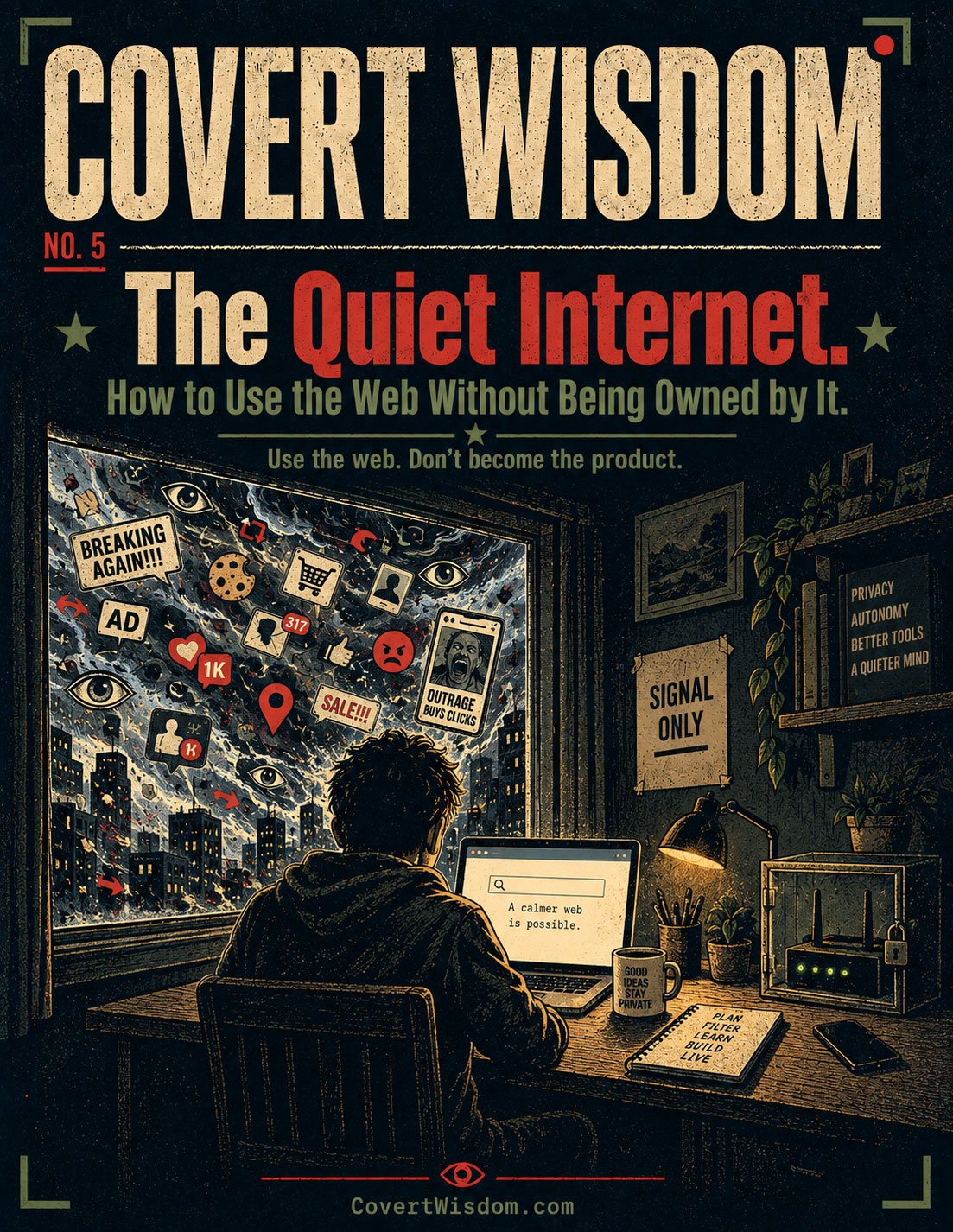
COVERT WISDOM #5
THE QUIET INTERNET
How to Use the Web Without Being Owned by It
This is not a guide to deleting the internet.
It is not a lecture about throwing away your phone.
It is not digital monk nonsense.
The internet is still one of the most useful tools ever created.
It is a library.
A marketplace.
A publishing system.
A research tool.
A workshop.
A communication network.
A discovery engine.
A way to learn almost anything.
The problem is not the web.
The problem is entering it without a plan.
Because the loud web has one.
It knows exactly what it wants from you.
Your attention.
Your reactions.
Your clicks.
Your fear.
Your curiosity.
Your purchases.
Your outrage.
Your habits.
Your time.
And if you do not decide how you use the internet, somebody else will happily decide for you.
THE LOUD WEB IS NOT AN ACCIDENT
Notifications.
Autoplay.
Infinite scroll.
Trending stories.
Recommended content.
Sponsored results.
Suggested posts.
Breaking-news banners.
Shopping prompts.
Algorithmic recommendations.
None of this is random.
It is designed to keep you inside.
Keep you reacting.
Keep you clicking.
Keep you coming back.
The web does not need to control your entire life.
It only needs to interrupt it constantly.
That is enough.
Because once your attention can be interrupted on demand, somebody else has partial control over what you think about next.
The Quiet Internet shows you how to take that control back.
THE FEED IS NOT THE INTERNET
One of the biggest ideas in this issue is simple:
The feed is only one tiny part of the web.
Yet millions of people experience the internet almost entirely through algorithmic feeds.
Open app.
Scroll.
Click.
React.
Compare.
Repeat.
Forget why you opened the thing in the first place.
But the web is much larger than that.
There are still:
Direct websites.
Independent publishers.
Archives.
Forums.
Databases.
Manuals.
Blogs.
Search tools.
Digital libraries.
Saved references.
Private workspaces.
Useful communities.
Real tools.
The feed is where platforms lead you.
The web is where you decide to go.
That difference changes everything.
BUILD A QUIETER BROWSER
Your browser should be a tool bench.
Not a casino lobby.
In this issue, you will see how to turn your browser into something that helps you get things done instead of constantly inventing more things for you to look at.
You will learn why it helps to:
- Keep a clean homepage.
- Use bookmarks as direct routes.
- Reduce unnecessary notifications.
- Separate work, research, shopping, and entertainment.
- Use reader mode when possible.
- Review extensions.
- Clean up tab clutter.
- Use stronger privacy defaults.
- And stop treating 57 open tabs like a personality trait.
A browser can either become another source of noise...
...or the control panel for a quieter internet.
SEARCH WITHOUT BEING STEERED
Search feels neutral.
It rarely is.
Sponsored results.
Autocomplete.
Trending queries.
Personalization.
SEO bait.
Shopping results.
“People also ask.”
Recommended content.
The first thing you see is not always the best answer.
It is simply the first thing the system decided to put in front of you.
The Quiet Internet gives you a simple set of questions to ask before trusting the first page.
Who benefits if I click this?
Is this an ad?
Is the source original?
Am I seeing what is useful...
...or what is optimized?
Did autocomplete frame the question before I even asked it?
Because search is not only about finding.
Search is framing.
STOP TEACHING THE MACHINE HOW TO BAIT YOU
Algorithms do not need to understand who you are.
They only need to understand what keeps you engaged.
Anger.
Fear.
Loneliness.
Envy.
Boredom.
Outrage.
Insecurity.
Impulse.
Every emotional click teaches the system something.
What you watch when you are lonely.
What you buy when you are anxious.
What you search when you are afraid.
What drama you cannot resist.
Who you compare yourself to.
What makes you angry enough to stay.
The result?
More of the same.
The machine keeps learning how to pull the lever.
This issue shows you how to add friction before those moments become training data.
Do not teach the machine how to bait you.
USE THE DIRECT ROUTE METHOD
Most wasted time online begins with one innocent sentence:
“I’ll just check.”
Then:
You open the app.
You scroll.
You click.
You react.
You compare.
And twenty minutes later you cannot remember why you opened it.
The Direct Route Method replaces drift with destination.
The process is simple:
- Know why you are going online.
- Go directly to the tool or source.
- Get the answer, file, message, asset, or update.
- Save what matters.
- Exit before drift begins.
Enter with a reason. Leave with the result.
That one habit can change the way the internet feels.
BUILD YOUR OWN INDEX
If you rely entirely on feeds and search engines, someone else controls your route.
So build your own.
Trusted websites.
Useful tools.
Reference material.
Niche communities.
Favorite archives.
Suppliers.
Research sources.
Project links.
Saved articles.
Offline notes.
A personal index gives you direct access to the things that matter to you.
No recommendation engine required.
No trending page required.
No permission required.
A bookmark may seem trivial.
But in a web designed around algorithmic discovery...
a bookmark is a tiny act of independence.
TURN OFF THE REMOTE CONTROL
Every notification says the same thing:
Stop your life and look here.
Some alerts matter.
Most do not.
So why should every app, store, social network, news source, game, website, and stranger have the right to interrupt you whenever they want?
This issue gives you a straightforward notification policy:
Humans and urgent systems get priority.
Marketing alerts get turned off.
Social alerts get reduced.
Email gets checked in batches.
Lock-screen noise disappears.
Impulse-generating apps lose access.
Attention becomes opt-in.
Not default.
Because:
If everything can interrupt you, nothing belongs to you.
MAKE PRIVACY THE DEFAULT
Most people treat privacy like emergency cleanup.
Something leaks.
Something goes wrong.
Then they start changing settings.
The Quiet Internet flips that around.
Privacy becomes the starting position.
Location off unless needed.
Camera asks first.
Microphone asks first.
Contacts stay private.
Cookies get limited.
Public posts get reviewed.
Data sharing gets reduced.
Profiles stay controlled.
Because defaults are not neutral.
They are decisions somebody else made before you arrived.
You are allowed to change them.
BUILD A QUIET INTERNET RITUAL
You do not need a complicated productivity system.
You need repeatable habits.
This issue gives you a simple daily quiet-web ritual:
Start with the task, not the feed.
Check direct sources first.
Save useful material immediately.
Close loops before opening new ones.
Avoid emotional browsing.
Turn off the noise when you are finished.
Leave before drift takes over.
Then reset once a week.
Clear tabs.
Review bookmarks.
Delete junk accounts.
Check privacy settings.
Clean downloads.
Unsubscribe from noise.
Save useful research.
Rebuild your direct routes.
A quiet internet is not created by one dramatic detox.
It is built one controlled session at a time.
PLUS: TWO PRACTICAL TOOLS YOU CAN ACTUALLY USE
This issue does not stop at ideas.
You also get:
THE QUIET INTERNET CHECKLIST
A practical pre-browse checklist covering:
- Entry.
- Search.
- Attention.
- Privacy.
- Noise.
- Exit.
Use it before you browse, post, search, buy, click, or react.
And...
THE QUIET INTERNET SCORECARD
Score yourself across five areas:
- Intentional Entry.
- Attention Control.
- Search Discipline.
- Privacy Defaults.
- Personal Index.
Find out whether you are:
Owned by the Feed
Noisy but Recoverable
Controlled User
or
Quiet Operator
Then use the result to decide what to fix first.
THE GOAL IS NOT LESS INTERNET.
THE GOAL IS LESS SURRENDER.
The web can still be useful.
Powerful.
Interesting.
Profitable.
Educational.
Creative.
Entertaining.
You do not have to reject it.
You just have to stop entering it unarmed.
Use direct routes.
Protect your attention.
Control your defaults.
Build your own index.
Turn off the noise.
Leave when the task is done.
The quiet internet is not empty.
It is chosen.
GET COVERT WISDOM #5
THE QUIET INTERNET
How to Use the Web Without Being Owned by It
Less feed. More signal.
Use the web. Don’t become the product.