The shot is only the beginning.
Most people think harvesting meat ends when the animal hits the ground.
It doesn’t.
That is when the real work starts.
Now you have a warm carcass.
Body heat is still trapped inside it.
Flies can find it.
Bacteria have time to work.
The digestive tract is still inside.
You may be miles from refrigeration.
And every decision you make from this point forward determines whether that animal becomes months of good food...
...or a pile of wasted meat.
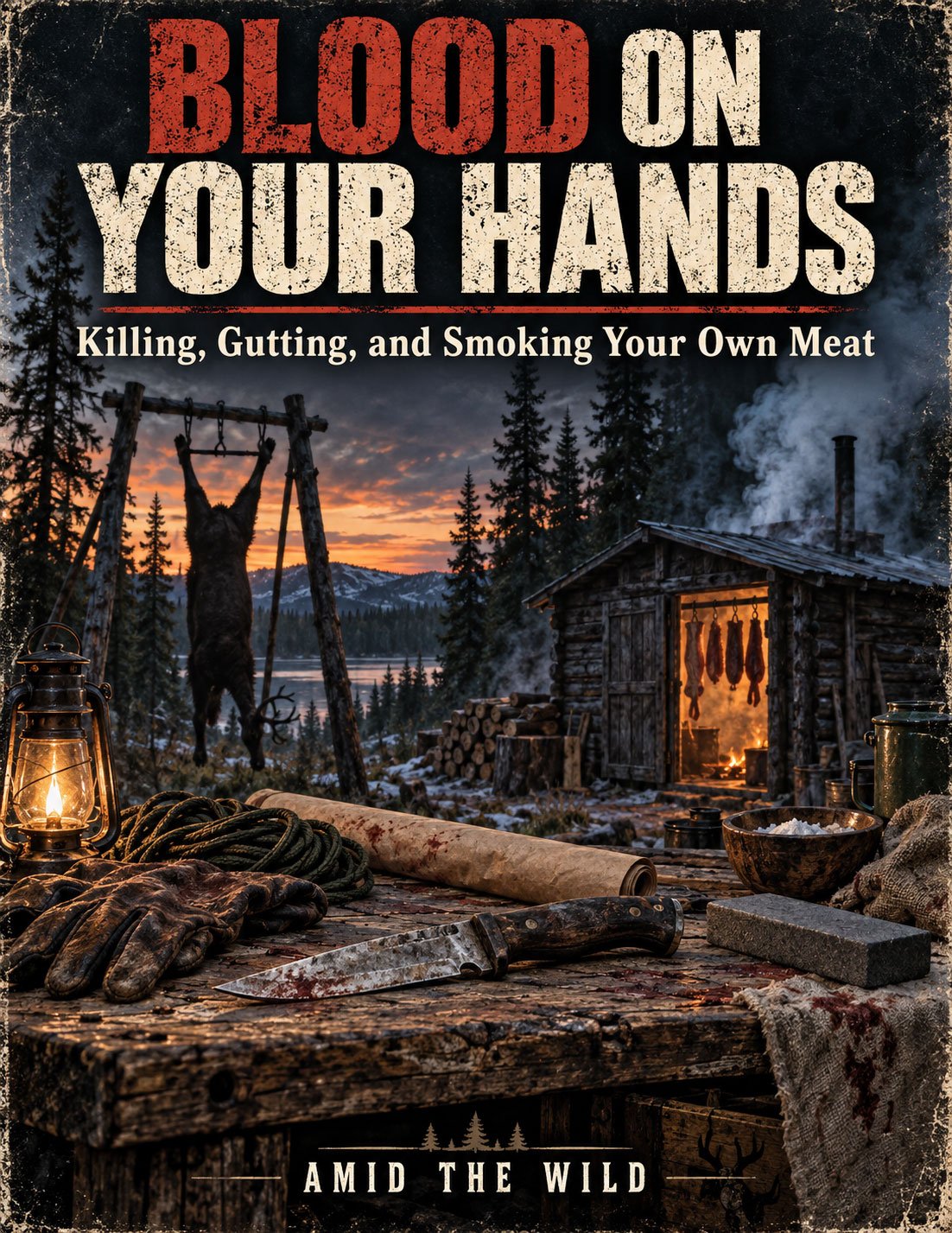
BLOOD ON YOUR HANDS is a practical field guide to the part of hunting that happens after the trigger is pulled.
Not trophy photos.
Not gear obsession.
Not macho storytelling.
Food.
The complete chain from animal to carcass, carcass to cuts, cuts to preserved meat, and preserved meat to a dependable food cache.
MEAT DOESN’T START AT THE BUTCHER COUNTER
Walk into a supermarket and meat has already been cleaned up for you.
No hide.
No organs.
No body heat.
No field recovery.
No flies.
No dirt.
No blood pooling inside a carcass.
No question about whether you can get
80 pounds of warm meat cooled before it starts going bad.
Someone else handled all of that.
BLOOD ON YOUR HANDS starts before the butcher counter.
It shows you the forgotten middle ground between harvesting an animal and eating it.
Because taking an animal is one skill.
Turning it into usable food is another.
THE FOUR ENEMIES ARE ALREADY WORKING
Once the animal is down, you are dealing with four problems:
HEAT
A large carcass can hold internal heat for hours.
CONTAMINATION
Hair, dirt, digestive contents, dirty water, insects, and careless handling can ruin clean meat.
MOISTURE
Uncontrolled moisture creates ideal conditions for deterioration.
TIME
Every other problem gets worse while you wait.
The guide teaches you to manage all four as one system instead of stumbling through the process one emergency at a time.
BEFORE YOU EVER NEED THE KNIFE
One of the biggest mistakes happens before the hunt.
You take an animal...
Then realize:
You don’t have enough cooler space.
You forgot game bags.
The recovery is farther than expected.
The temperature is climbing.
The freezer is already full.
Your only knife is dull.
Or the animal is simply bigger than the system you brought with you.
That is why this guide starts with preparation.
You’ll learn to think about:
- animal size
- expected meat yield
- recovery distance
- terrain
- weather
- storage capacity
- disease concerns
- transport
- refrigeration
- backup preservation methods
Because the real question isn’t:
Can I take this animal?
It is:
Can I recover, cool, process, and store it?
That distinction runs through the entire guide.
BUILD A FIELD KIT THAT ACTUALLY DOES SOMETHING
You do not need a truck full of expensive hunting gadgets.
You need equipment that solves six jobs:
CUT.
CLEAN.
COOL.
PROTECT.
MOVE.
SEE.
Inside, you’ll build a practical field-processing system around:
- primary and backup knives
- sharpening
- gloves
- breathable game bags
- clean working surfaces
- cord
- coolers
- ice and frozen water
- temperature monitoring
- first aid
- lighting
- vehicle-side processing gear
The idea is simple:
If one inexpensive tool can stop the entire process when it fails, carry two.
This is preparedness stripped down to what actually matters.
THE HUNT ENDS. THE RESPONSIBILITY BEGINS.
The guide walks through the transition from hunter to food handler.
You’ll learn how to think through:
- recovery
- confirming the animal before handling
- tagging and documentation
- external inspection
- field conditions
- shot damage
- what happens next when conditions change
Because once the animal is recovered, the priorities become brutally simple:
Keep it clean.
Get the heat out.
Avoid unnecessary delay.
Protect exposed meat.
The hunt is over.
Now you are responsible for food.
HEAT IS THE FIRST ENEMY
A cool evening does not mean the center of a large quarter is cool.
A whole carcass is an insulated mass.
Hide holds heat.
Hair holds heat.
Fat holds heat.
Muscle holds heat.
Internal organs hold even more.
BLOOD ON YOUR HANDS teaches you to think in terms of:
Reduce mass. Increase exposed surface. Improve airflow.
You’ll understand when shade matters...
when quartering helps...
when skinning helps...
when plastic hurts...
how coolers should actually be used...
and why guessing at meat temperature is a poor substitute for measuring it.
FIELD DRESSING WITHOUT TURNING THE CARCASS INTO A MESS
Field dressing is not:
“Cut it open and pull everything out.”
Done carelessly, you can spread digestive contents, urine, hair, dirt, and bacteria across otherwise clean meat.
The guide shows you how to organize the job around one operating principle:
Open carefully. Separate clean from dirty. Remove heat. Protect exposed meat.
You’ll learn how to think about:
- work positioning
- clean and dirty zones
- controlled opening cuts
- avoiding digestive contamination
- what to do if the gut is punctured
- edible organs
- internal inspection
- airflow
- debris removal
- knife discipline
- water use
- knowing when something looks wrong
The carcass doesn’t need to leave the field looking pretty.
It needs to leave cleaner, cooler, and better protected than when you started.
WHOLE CARCASS? QUARTERS? BONE IT OUT?
There is no one correct answer.
Conditions decide.
You’ll learn how to choose between:
WHOLE-CARCASS TRANSPORT
Minimal field cutting and maximum protection.
QUARTERING
Less weight and faster cooling.
BONING OUT
Maximum weight reduction for difficult recoveries.
And you’ll understand the tradeoffs between cooling, contamination, exposed surface area, transport weight, terrain, and legal requirements.
STOP SEEING “A CARCASS”
Start seeing:
hindquarters
shoulders
backstraps
tenderloins
neck
ribs
shanks
trim
organs
bones
That change alone transforms butchery.
Instead of hacking pieces off, you begin following joints, fascia, bone contours, and natural seams.
You learn which muscles want to become steaks...
which want slow cooking...
which belong in the grinder...
and which are ideal for preservation.
THE FOUR-PILE SYSTEM
One of the easiest ways to simplify processing is to stop deciding the final destiny of every individual piece.
Sort meat into four working categories:
PREMIUM
Backstraps, tenderloins, suitable roasts.
SLOW-COOK
Shoulder, neck, shanks, connective-tissue-heavy meat.
GRIND
Clean trim and awkward pieces.
PRESERVATION
Lean cuts for jerky, drying, smoking, canning, or tested curing.
Now butchery becomes a system instead of a pile of meat and indecision.
“NOTHING WASTED” DOESN’T MEAN “EAT EVERYTHING”
This guide has no interest in performative toughness.
You’ll learn how to make use of overlooked parts like:
- heart
- liver where appropriate
- tongue
- neck
- shanks
- rib meat
- trim
- bones
- usable fat
But you’ll also learn when to stop.
Contaminated meat does not become noble because you refuse to discard it.
Diseased or questionable tissue does not become safe because wasting food makes you uncomfortable.
Nothing wasted means nothing useful is discarded through ignorance or carelessness.
That is a very different philosophy.
THEN THE GUIDE GOES BEYOND THE HUNT
Because raw meat is temporary.
Preserved meat is inventory.
BLOOD ON YOUR HANDS takes the process into:
DRYING AND JERKY
Learn why uniform thickness, lean meat, heat, airflow, moisture removal, and storage all matter.
SMOKING
Understand the real differences between hot smoking, cold smoking, and smoke-drying.
And why:
Smoke is not magic.
SALT AND CURING
Move beyond handfuls and folklore into measured, controlled processes using weight, time, temperature, and the correct curing method.
PRESSURE CANNING
Understand why properly canned meat can create true independent shelf storage while frozen meat still depends on power.
SHELF STABILITY
Learn the critical difference between something that merely looks preserved and food that has actually gone through a process capable of supporting room-temperature storage.
VACUUM SEALED DOESN’T MEAN PRESERVED.
SMOKED DOESN’T MEAN PRESERVED.
SALTY DOESN’T MEAN PRESERVED.
A SEALED JAR DOESN’T MEAN SAFELY CANNED.
That kind of false confidence ruins food.
Sometimes it does worse.
This guide teaches you to ask the better question:
What exactly makes this food safe without refrigeration?
If you cannot answer that, keep it cold.
BUILD A MEAT CACHE, NOT JUST A FREEZER
A freezer packed with meat feels like security.
Until the power goes out.
Then every pound shares the same failure point.
The guide teaches a layered approach:
ACTIVE FOOD
What you are eating now.
FROZEN FOOD
Bulk seasonal storage.
DRIED FOOD
Portable preserved food.
SHELF-STABLE FOOD
Properly canned and validated preserved products.
RESERVE FOOD
Storage that does not depend on the primary freezer.
Different forms.
Different failure points.
Actual redundancy.
THE ENTIRE PROCESS BECOMES ONE WORKFLOW
The final sections turn the whole guide into a repeatable operating system:
PLAN
Know the animal.
Know the law.
Know the conditions.
Know where the meat will go.
↓
HARVEST
Identify.
Take responsibly.
Observe.
Recover.
↓
PROTECT
Inspect.
Field dress.
Control contamination.
Remove heat.
↓
BREAK DOWN
Whole.
Quartered.
Boned.
Sorted.
↓
PRESERVE
Fresh.
Frozen.
Dried.
Smoked.
Cured.
Canned.
↓
STORE
Label.
Divide.
Protect.
Rotate.
AND YOU GET THE QUICK-REFERENCE FIELD MANUAL
The end of the guide strips the whole system down into a field-ready operating reference covering:
- pre-hunt checks
- field kit
- after-shot procedure
- recovery
- carcass inspection
- clean field dressing
- cooling priorities
- whole vs. quartered vs. boned-out
- basic anatomy
- preservation decisions
- jerky
- smoking
- curing
- canning
- shelf stability
- cache storage
- freezer failure
- red flags
- final field checklist
Not another chapter to read.
Something to use.
THIS ISN’T ABOUT BLOOD FOR THE SAKE OF BLOOD.
It isn’t about pretending modern refrigeration never existed.
And it isn’t about cosplay survivalism.
It is about recovering one of the most fundamental food skills humans ever had:
Knowing what has to happen between a living animal and safe food.
Taking responsibility for the entire chain.
From harvest.
To carcass.
To cut.
To preserved food.
To cache.
To dinner months later.
The butcher counter is simply where most people enter the story.
BLOOD ON YOUR HANDS starts earlier.
BLOOD ON YOUR HANDS
Killing, Gutting, and Smoking Your Own Meat
A Field Guide to Harvesting, Processing, and Preserving Wild Meat
Inside you’ll learn how to:
- prepare before the harvest
- build a functional field-processing kit
- recover and inspect an animal
- control heat and contamination
- field dress cleanly
- decide between whole, quartered, and boned-out transport
- understand the anatomy that matters
- butcher without unnecessary waste
- use overlooked cuts and organs
- dry meat and make jerky
- understand hot smoke, cold smoke, and smoke-drying
- use salt and curing correctly
- recognize what actually makes meat shelf-stable
- build a redundant meat cache
- run the entire harvest-to-storage process as one system
- use the included quick-reference field manual
THE ANIMAL PROVIDES THE MEAT.
YOUR DECISIONS DETERMINE WHAT HAPPENS TO IT.
Get BLOOD ON YOUR HANDS and learn the complete harvest-to-cache system.