AI is changing again.
For the first few years, most of us used it the same way:
Open a chatbot.
Ask a question.
Get an answer.
Copy the result.
Go do the actual work.
That model is already starting to look old.
AI can increasingly read information, work across tools, react to events, prepare actions, update systems, monitor activity and perform parts of a workflow without waiting for you to type another prompt.
That creates a much bigger opportunity.
And a much bigger problem.
Because once AI can act, the important question is no longer:
“What can AI generate?”
It becomes:
“What is AI allowed to do?”
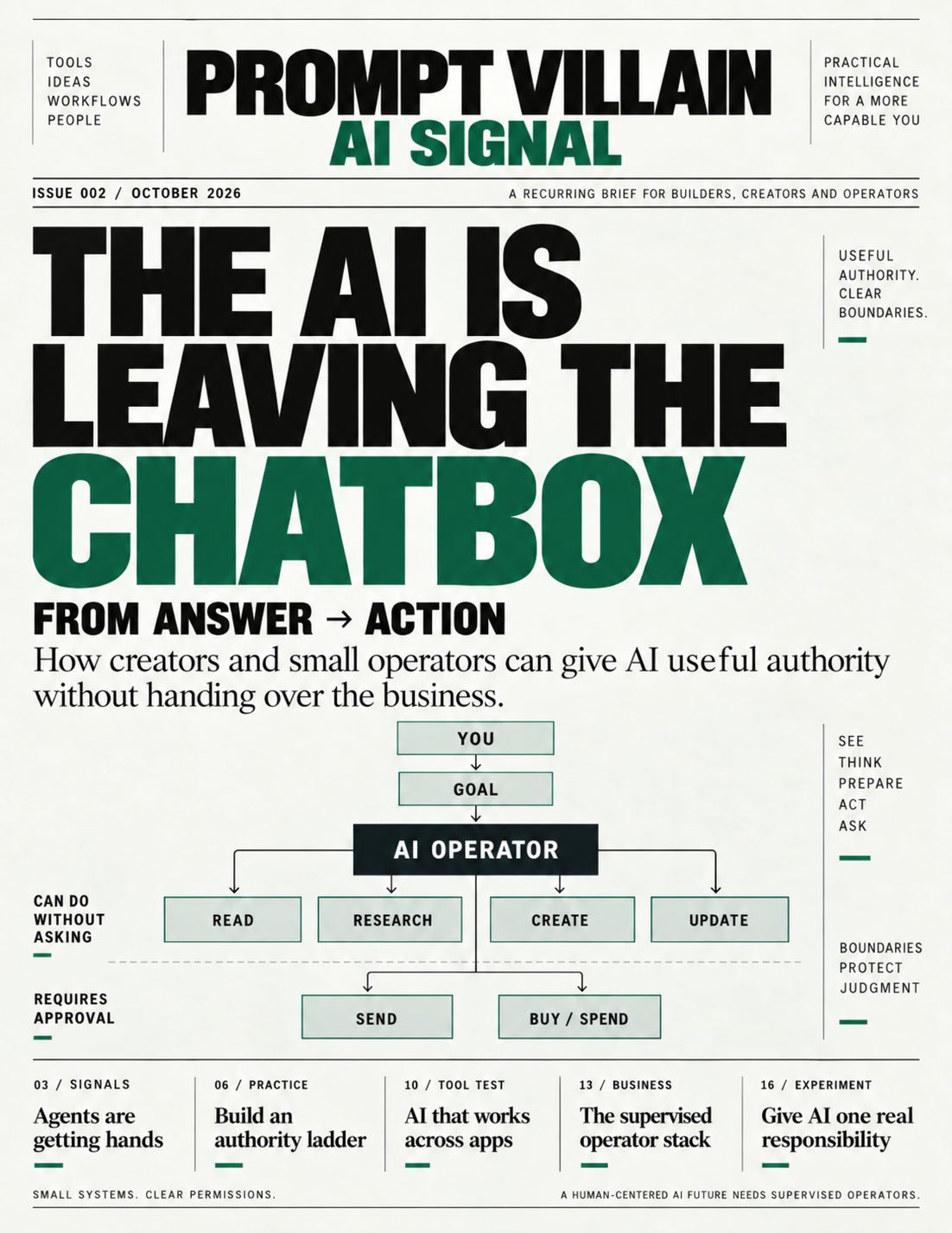
That is the subject of Prompt Villain AI Signal — Issue 2: THE AI IS LEAVING THE CHATBOX.
FROM ANSWER → ACTION
This issue is a practical field guide for creators, entrepreneurs and small operators who want to move beyond basic prompting and begin using AI as a supervised operator.
Not an imaginary autonomous employee.
Not a giant agent that supposedly runs your business.
Not another collection of clever prompts.
A bounded system with:
A job.
A trigger.
Context.
Tools.
Permissions.
Limits.
Approval gates.
Logs.
Human oversight.
The goal is simple:
Give AI enough authority to remove work — but not enough authority to create unnecessary risk.
The issue breaks down exactly what an acting AI needs and shows why permissions, limits, escalation rules and approval gates matter just as much as the intelligence itself.
YOU’LL LEARN HOW TO BUILD AN AUTHORITY LADDER
One of the biggest mistakes people can make with AI agents is jumping directly from:
CHATBOT
to:
AUTOPILOT
AI Signal Issue 2 introduces a much safer progression.
LEVEL 0 — ANSWER
AI explains.
LEVEL 1 — READ
AI inspects approved information.
LEVEL 2 — PREPARE
AI gets an action ready.
LEVEL 3 — ACT WITH APPROVAL
AI proposes the action and waits for you.
LEVEL 4 — ACT WITHIN LIMITS
AI performs specific reversible actions automatically.
LEVEL 5 — AUTONOMOUS EXECUTION
AI acts without prior approval.
And the operating rule is intentionally conservative:
START ONE LEVEL BELOW WHAT FEELS POSSIBLE.
Because more power should come with more supervision — not less.
SEE WHAT SUPERVISED AUTONOMY ACTUALLY LOOKS LIKE
We take the idea out of theory and put it into a simple one-person store.
A new order arrives.
AI can:
Read the order.
Check inventory.
Review customer history.
Prepare fulfillment information.
Update an approved record.
Queue a follow-up.
But if something unusual happens — a high-value order, strange address or inventory mismatch — the system stops.
HUMAN REVIEW.
The same operator can prepare a weekly business brief by reviewing sales, refunds, inventory, ad performance and customer messages…
…but it does not change prices, issue refunds or spend money without approval.
That is the difference between useful automation and reckless automation.
DISCOVER WHY THE BEST AGENT MAY NEVER NEED A PROMPT
Most people still think AI starts when they open a chat window.
But a more useful system can begin when something happens.
NEW CUSTOMER
→ prepare onboarding
NEW REVIEW
→ classify + draft reply
LOW INVENTORY
→ investigate + alert
MONDAY MORNING
→ prepare business brief
NEW PRODUCT
→ create promotional asset queue
FAILED PAYMENT
→ prepare recovery message
Instead of:
YOU REMEMBER → OPEN AI → ASK → COPY → ACT
you can begin designing:
EVENT → SYSTEM WAKES UP → WORK HAPPENS
Because a trigger converts AI from something you visit into something that operates.
LEARN WHAT AI SHOULD REMEMBER — AND WHAT IT SHOULD LOOK UP FRESH
Persistent context sounds useful.
Until old information quietly becomes bad information.
Issue 002 separates:
REMEMBER
Business rules
Brand standards
Approved products
Customer categories
Tool configurations
Output requirements
from:
LOOK UP FRESH
Prices
Inventory
Policies
Schedules
Current metrics
Account status
And warns against treating:
Old guesses
Temporary instructions
Past errors
Unverified assumptions
as current truth.
The principle is simple:
MEMORY IS CONTEXT. SYSTEMS OF RECORD ARE TRUTH.
TEST THE NEW CONNECTED-AI MODEL
This issue also looks at tools and approaches that point toward the next operating model.
You’ll see practical breakdowns of connected AI assistants and model routing — including the idea that you may not need one “favorite AI model” at all.
Different jobs may need different intelligence.
CHEAP MODEL
Classification.
FAST MODEL
Routine rewriting.
DEEP MODEL
Analysis and planning.
VISION MODEL
Image inspection.
SPECIALIST MODEL
Code, audio, video and other task-specific work.
The operator rule:
Use the least expensive reliable intelligence that can perform the job.
BUILD AN APPROVAL QUEUE INSTEAD OF LETTING AI INTERRUPT YOU ALL DAY
AI performs the routine preparation.
Completed work goes into an:
APPROVAL QUEUE.
Then you decide:
APPROVE
Do it.
EDIT
Change something.
REJECT
Don’t do it.
ESCALATE
Needs deeper judgment.
That changes the relationship.
Instead of you constantly managing AI…
AI does the preparation.
You make the call.
THERE MAY BE A BUSINESS HIDDEN INSIDE THIS SHIFT
Small businesses do not necessarily need another AI consultant telling them which model is exciting this week.
They may need somebody who can say:
“I’ll identify three things your business repeatedly handles, connect the information required, establish safe permissions, build approval gates and document the system.”
Issue 2 explores the emerging opportunity around the:
AI OPERATOR INSTALLER
Potential services include:
AI Workflow Audits
Agent Installation
Permission Design
Business Context Packs
Approval Systems
Monthly Agent Maintenance
Not selling AI hype.
Installing useful systems.
AND THEN WE DEAL WITH THE PART THE HYPE USUALLY SKIPS
A bad chatbot answer is annoying.
A bad acting agent can:
Send an email.
Delete a file.
Contact a customer.
Change a price.
Spend money.
Expose private information.
The danger changes when the AI has authority.
Issue 2 gives you a practical framework for deciding what should generally be:
PERMITTED
TESTED
APPROVED
or kept under:
HUMAN CONTROL
The more irreversible the action, the more human approval should rise.
AUTONOMY IS NOT FREE.
A system can perform more work by itself and still be worse for your business.
So we measure:
Reasoning cost
Tool cost
Retries
Supervision
Correction
Failure consequences
The wrong question is:
“Did the AI complete the task itself?”
The better question is:
“Was total human effort reduced without increasing unacceptable risk?”
THEN YOU BUILD ONE.
Not a giant agent.
Not an autonomous company.
Not a 47-step automation maze.
One real responsibility.
The included experiment walks you through giving AI something small and measurable — such as preparing a daily business status brief.
You define:
What it may do.
What it may not do.
What requires approval.
When you review it.
How you measure whether it is actually helping.
INCLUDED: YOUR AI AUTHORITY SPECIFICATION
Issue 2 includes a practical tear-out worksheet for defining your own operator.
You’ll specify:
Operator Name
Responsibility
Trigger
What It May Read
What It May Remember
What It May Create
What It May Change
What It May Never Do
When It Must Ask
What Must Be Logged
How A Human Reviews It
Success Condition
And one field that matters more than most people realize:
SHUT-OFF CONDITION
Because a good AI operator is defined.
Not assumed.
YOU ALSO GET THE 7-DAY INSTALL
The issue ends with a practical seven-day implementation sequence.
DAY 1
Choose one repeated responsibility.
DAY 2
Write the trigger and desired outcome.
DAY 3
List required context and sources.
DAY 4
Define permissions and prohibited actions.
DAY 5
Add human approval gates.
DAY 6
Run it on old or low-risk work.
DAY 7
Decide:
EXPAND / HOLD / RESTRICT / KILL
And every operator has to pass four questions:
WHAT CAN IT SEE?
WHAT CAN IT DO?
WHEN MUST IT ASK?
CAN I UNDO IT?
If you cannot answer those four questions clearly, the operator is not ready.
THIS IS NOT ANOTHER “WHAT’S NEW IN AI?” REPORT.
AI Signal is designed around a different standard.
What changed?
Why does it matter?
What can you actually do with it?
Where can it go wrong?
Issue 1 established that the prompt was becoming infrastructure.
Issue 2 takes the next step.
THOSE SYSTEMS NOW HAVE HANDS.
Which means builders need to think about more than intelligence.
They need to think about authority.
PROMPT VILLAIN AI SIGNAL — ISSUE 2
THE AI IS LEAVING THE CHATBOX
FROM ANSWER → ACTION
For creators, entrepreneurs and small operators who want to use AI to perform real work while keeping judgment, permissions and consequential decisions where they belong.
Inside:
20 tightly designed pages
Practical operating frameworks
Real workflow examples
Tool tests
Authority Ladder
Approval Queue
Risk Framework
Business Model Watch
Operator Experiment
AI Authority Worksheet
7-Day Installation Plan
No giant theory dump.
No “AI will run everything” fantasy.
No need to surrender the keys.
GIVE AI WORK.
GIVE IT BOUNDARIES.
KEEP THE KEYS.
Get Prompt Villain AI Signal — Issue 2 today.